Custom WordPress Theme vs Page Builder: When Each Makes Sense
Custom WordPress theme or page builder for agency builds? Honest decision framework, real cost math, and the 4 scenarios where custom wins.
Custom WordPress Theme vs Page Builder: When Each Makes Sense
A custom WordPress theme wins for high-traffic enterprise sites where every millisecond matters, sites needing complete design freedom outside any builder’s constraints, and long-term portfolios where the agency wants to own the technical stack end-to-end. A page builder (Elementor, Bricks, Divi) wins for 90% of agency work — speed-to-ship, ease of client handoff, ecosystem of plugins and templates, and team-wide build capability. The build-vs-buy decision usually answers itself within the first 10 minutes of project discovery if the questions are framed correctly.
Honestly, the most common version of this conversation is an agency owner trying to talk themselves into custom because it feels more “professional.” It’s not professionalism — it’s a 2-3x project cost. Make sure the reason is real.
TL;DR — page builders win 90% of agency work
For most agency builds, the page-builder answer is correct. The reasoning compounds across four operational realities:
- Build speed. A 20-page client site ships in 50-70 hours on Elementor or Bricks; the same site on a custom theme takes 120-180 hours. That’s a 2-3x dev cost difference per project, multiplied across an entire portfolio.
- Team-wide build capability. Page builders let junior or mid-level staff ship production work. Custom themes require senior developers for every project, which constrains throughput.
- Client editability post-launch. Page-builder clients can update their own pages confidently. Custom theme clients usually need to call the agency for changes, which inflates support cost.
- Ecosystem coverage. Page builders integrate with thousands of plugins and templates out of the box. Custom themes integrate with whatever you build for them.
For most agency work, picking a page-builder and standardizing on it produces better economics than building custom themes from scratch. The harder question is when to break the default.
When custom theme wins (four scenarios)
1. Performance-critical enterprise
When a client site processes millions of pageviews per month and Core Web Vitals affect material revenue (e-commerce conversion, ad inventory yield, lead-gen ranking), the performance ceiling of even the best page builder (Bricks) sits below what a custom theme can hit.
Typical metrics on real builds:
- Best Bricks site: 92-98 Lighthouse Performance mobile, 150-220ms TTFB
- Equivalent custom theme: 96-100 Lighthouse, 80-150ms TTFB
The gap is 5-15 Lighthouse points and 70-100ms TTFB on the high end. For enterprise sites where every conversion percentage point translates to six figures of annual revenue, that’s worth the custom-theme build cost. For 95% of agency client sites, it isn’t.
2. Design beyond builder constraints
Some designs simply can’t be produced inside a page builder without ugly workarounds. Typical patterns:
- Complex parallax animations with scroll-tied state changes
- Interactive product configurators with custom 3D rendering
- Editorial layouts with unusual grid systems that break standard column models
- WebGL-driven hero sections or animations
Page builders can host these via custom code blocks but the result is usually fragile — the next builder update can break the custom code, and maintenance burden compounds. For agencies whose creative direction routinely produces designs that page builders can’t render cleanly, custom theme is the right call.
3. Long-term portfolio ownership
Some agencies take a strategic decision to own their stack end-to-end — custom base theme, custom components, custom build system — because the agency-wide investment compounds over years. The first custom theme costs 2-3x a page-builder build. Theme #20 is built on accumulated components and ships faster than a page-builder equivalent.
This only works for agencies committing 3-5+ years to the stack and having senior dev capacity to maintain it. For agencies that might switch builders or downsize the team, the investment doesn’t pay back.
4. Specific compliance or accessibility requirements
Government, healthcare, finance, and education clients sometimes require WCAG AAA accessibility, specific audit trails on code changes, or compliance with industry frameworks (FedRAMP, HIPAA-aware infrastructure) that page builders’ generated markup doesn’t reliably satisfy.
For these clients, every element on the page needs to be auditable, every accessibility attribute needs to be explicit, and every code path needs to pass static analysis. Custom themes give that control; page builders abstract too much of the markup generation.
When page builder wins (the default case)
For everything else — and “everything else” is roughly 90% of agency work — page builder is the right answer:
- Marketing brochure sites under 50 pages
- WooCommerce stores with standard product flows
- Blog and content sites
- Landing pages and lead-gen funnels
- Multi-client portfolios where the agency wants standardization
- Any project where client editability post-launch matters
- Any project under $30,000 in client budget
If the project doesn’t clearly fit one of the four custom-theme scenarios, default to a page builder. The economics, team capability, and client experience consistently favor the builder path.
The hybrid path — block themes plus Gutenberg plus custom
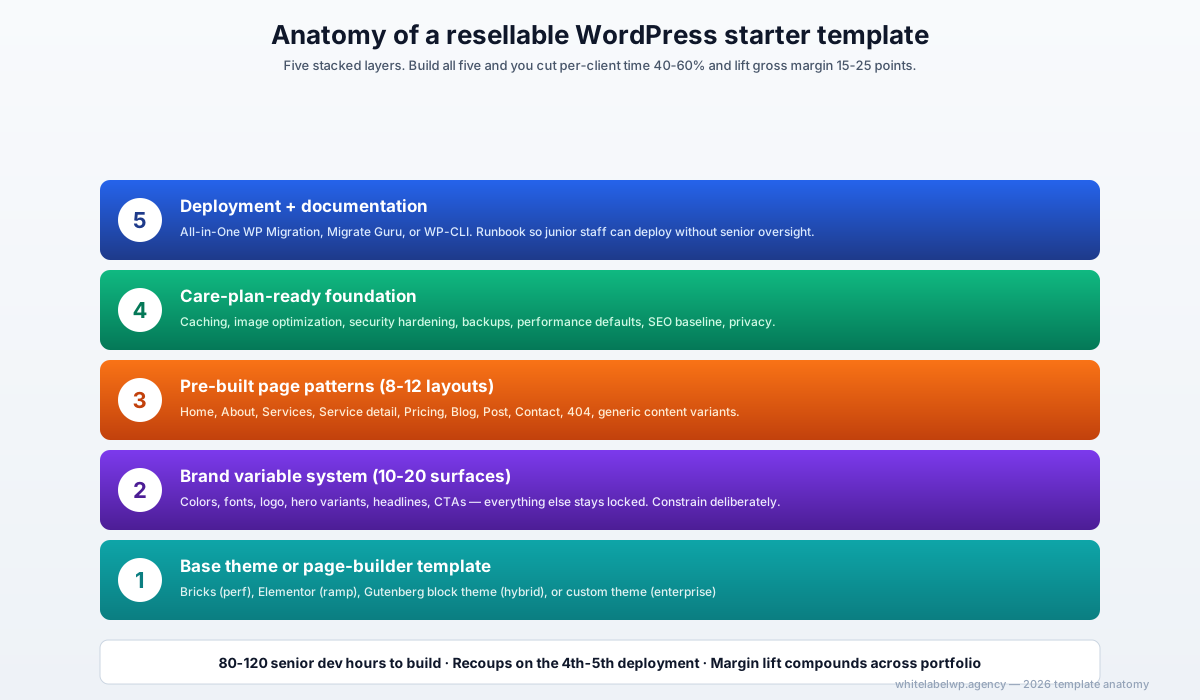
A growing middle option in 2026: Gutenberg block themes paired with custom block development. The block-theme model uses WordPress’s native full-site-editing infrastructure with theme-defined patterns, then adds custom blocks for any pattern outside the theme’s defaults.
Block themes that work well for agency use in 2026: GenerateBlocks Pro, Spectra, Kadence, and the official Twenty Twenty-Four / Twenty Twenty-Five themes paired with a custom child theme.
The hybrid path sits between page builder and full custom theme on cost and performance. A 20-page block-theme build takes 80-100 hours (vs 60 on Elementor, 120-180 on custom). Performance lands closer to custom themes than to page builders. Client editability is good (Gutenberg is native to WordPress, easier for content teams than page builders for many use cases).
For agencies experimenting with block themes, this is a real middle option in 2026, not just a transitional one. We expect block themes to take meaningful market share from page builders over the next 2-3 years.
Cost and timeline comparison
For a 20-page agency client site of equivalent design and content complexity:
| Approach | Dev hours | White-label cost to agency | Client price | Performance ceiling |
|---|---|---|---|---|
| Elementor | 50-70 | $1,500-$2,100 | $4,000-$8,000 | 80-90 Lighthouse |
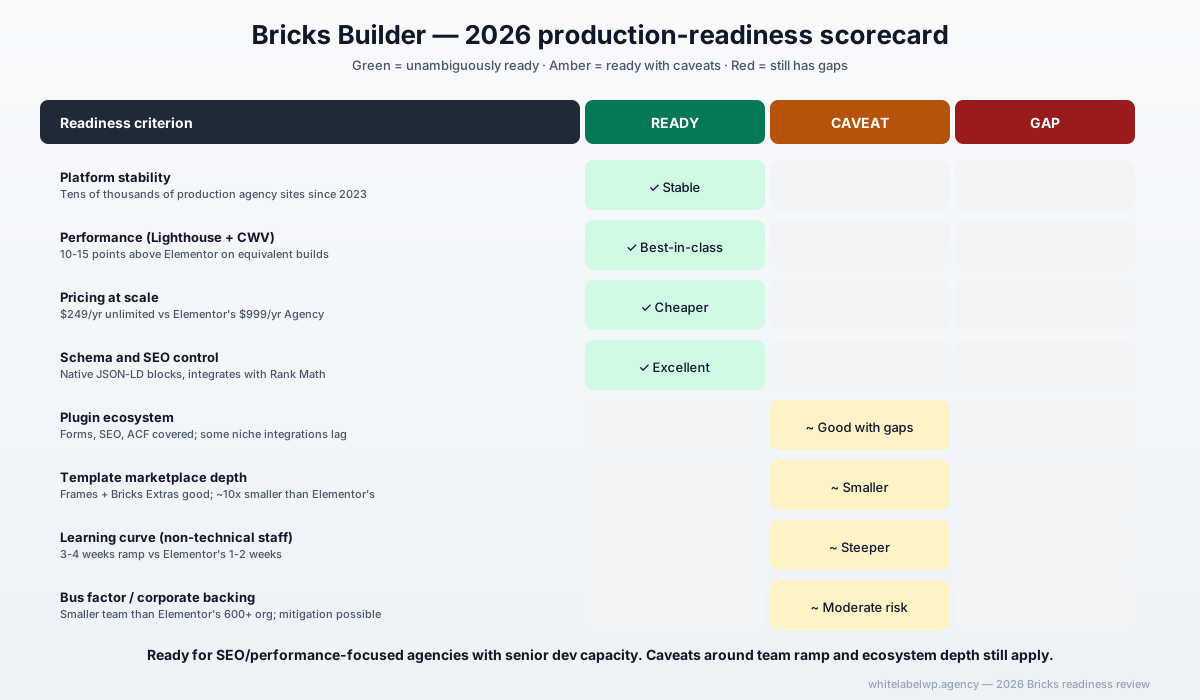
| Bricks | 55-75 | $1,650-$2,250 | $4,500-$9,000 | 92-98 Lighthouse |
| Gutenberg block theme | 80-100 | $2,400-$3,000 | $6,000-$12,000 | 93-99 Lighthouse |
| Custom theme | 120-180 | $3,600-$5,400 | $10,000-$25,000 | 96-100 Lighthouse |
The cost gap between page builder and custom theme is roughly $2,000-$3,000 in white-label cost and $6,000-$15,000 in client price. Whether that’s worth it depends on whether the project clears one of the four custom-theme scenarios above.
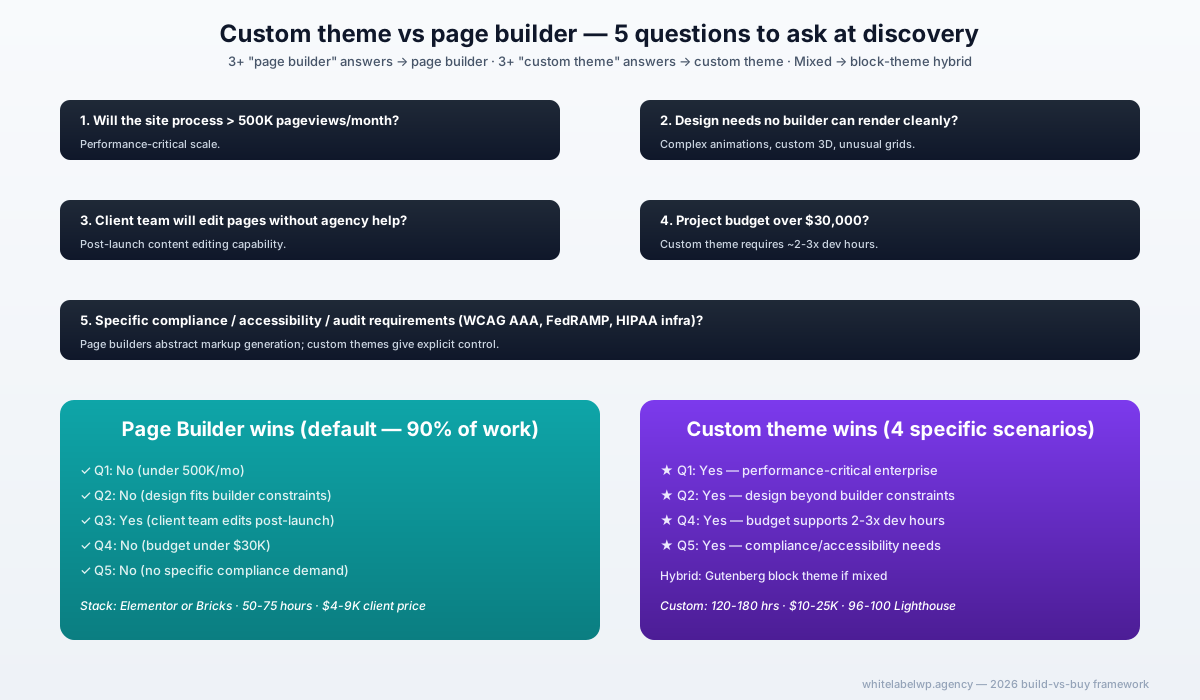
Decision framework — five questions to answer at discovery
Run these five questions at project discovery and the answer is usually obvious by question three.
- Is the client’s site projected to process more than 500,000 pageviews per month? If yes, lean toward custom theme. If no, page builder.
- Will the design require interactions, animations, or visual patterns that no page builder can produce cleanly? If yes, custom theme. If no, page builder.
- Will the client’s internal team need to update pages without agency help post-launch? If yes, page builder (custom theme requires dev help for changes).
- Is the project budget over $30,000? If yes, custom theme is feasible. If no, page builder is structurally required.
- Does the client have specific accessibility, compliance, or audit requirements? If yes, custom theme. If no, page builder.
Three or more “page builder” answers → page builder. Three or more “custom theme” answers → custom theme. Mixed → block-theme hybrid is often the right middle.
Where White Label WP Agency fits
We build in whatever stack the agency has standardized on. Page-builder work (Elementor, Bricks, Divi) fits comfortably inside our page-builder development service and inside Pro or Max retainers. Custom theme work and custom development is typically Max-retainer scope or project-priced.
For agencies at the build-vs-buy decision on specific projects, we run the five-question framework during brief intake. If the project fits a page builder, we tell you that; if it needs a custom theme, we tell you that too. Book a partner call to walk through your current pipeline and stack standards.
Frequently asked questions
Should I build a custom WordPress theme or use Elementor?
For 90% of agency work, use Elementor (or Bricks, or Divi). Page builders ship faster, hand off cleaner to clients, and let your team build without senior dev time. Build a custom theme only when you have one of four specific reasons: performance-critical enterprise client, design needs that no builder can produce, long-term agency-owned portfolio strategy, or specific compliance/accessibility requirements that page builders can’t meet.
How much faster is a custom WordPress theme than a page-builder site?
For equivalent designs, custom themes typically run 10-30% faster on Lighthouse Performance and 100-400ms lower on Time to First Byte. The gap exists but is smaller in 2026 than it was in 2020 — modern page builders (especially Bricks) have closed most of the structural performance disadvantage. For most client sites the speed difference doesn’t affect rankings or conversions; for high-traffic enterprise sites, the cumulative impact compounds.
How much more does a custom WordPress theme cost than a page-builder build?
Custom themes typically cost 2-3x more in dev time. A 20-page client site that takes 60 hours on Elementor takes 120-180 hours as a custom theme. White-label cost differential is roughly $3,000-$8,000 more per project. Whether that’s worth it depends on the project’s performance ceiling, design ambition, and lifetime maintenance horizon.
Can a page-builder site be converted to a custom theme later?
Yes, but it’s a rebuild, not a conversion. Plan 60-80% of a fresh-build cost to migrate a page-builder site to a custom theme. The conversion is usually only worth doing when the client’s site has grown into enterprise-scale traffic and the performance ceiling of the page builder is now a measurable revenue constraint.
What about Gutenberg block themes — are they a middle ground?
Yes, increasingly. Gutenberg block themes (Twenty Twenty-Four, Twenty Twenty-Five, Spectra, GenerateBlocks Pro) sit between custom themes and page builders on cost, performance, and ease of use. They’re maturing fast but as of 2026 they don’t fully replace either custom themes (for top-tier performance) or page builders (for client editability). For agencies experimenting with block themes, they work well as a middle option on small-to-mid client sites.
Can a white-label developer build either a custom theme or a page-builder site?
Yes — White Label WP Agency builds in whichever stack the agency has standardized on. Custom theme projects typically run as Max-retainer scope or project-priced. Page-builder builds (Elementor, Bricks, Divi) fit comfortably inside Pro or Max retainers. We’ll recommend the right approach based on the client’s scale and design requirements during brief intake.