Bricks Builder for Agency Partners: Production-Ready in 2026?
Is Bricks Builder production-ready for agency builds in 2026? Honest scorecard, where it wins, where it has gaps, and the 3 agency profiles it suits.
Bricks Builder for Agency Partners: Production-Ready in 2026?
Bricks Builder is production-ready for agency builds in 2026, with three caveats: your team needs at least one developer comfortable in HTML/CSS, your client mix should be SEO and performance-focused rather than ecosystem-and-template-driven, and your migration tolerance from Elementor should be high enough to absorb 30-40% manual rebuilds on existing portfolios. For agencies that meet those three conditions, Bricks delivers measurably faster sites at $249/year unlimited — a real upgrade. For agencies that don’t, Elementor is still the right call in 2026.
The honest read: “production-ready” is about team fit and client mix, not platform maturity. Bricks itself crossed the maturity line around 2023-2024. The question now is whether your agency is the right shape to use it well.
What “production-ready” means for an agency builder
A page builder is production-ready for an agency when four things are true:
- The platform is stable. No regressions in core features across version releases, no surprise breaking changes, no extended downtime on the vendor’s support infrastructure.
- The ecosystem fills the gaps. Templates, plugins, and third-party tooling cover the typical use cases your client mix requires without forcing custom development on every project.
- Your team can ship reliably. Daily delivery doesn’t trip on the builder’s quirks. Junior staff can learn it without burning months of senior time.
- The economics work across portfolio scale. Per-site pricing or licensing supports 20-100 client sites without forcing tier upgrades that destroy margin.
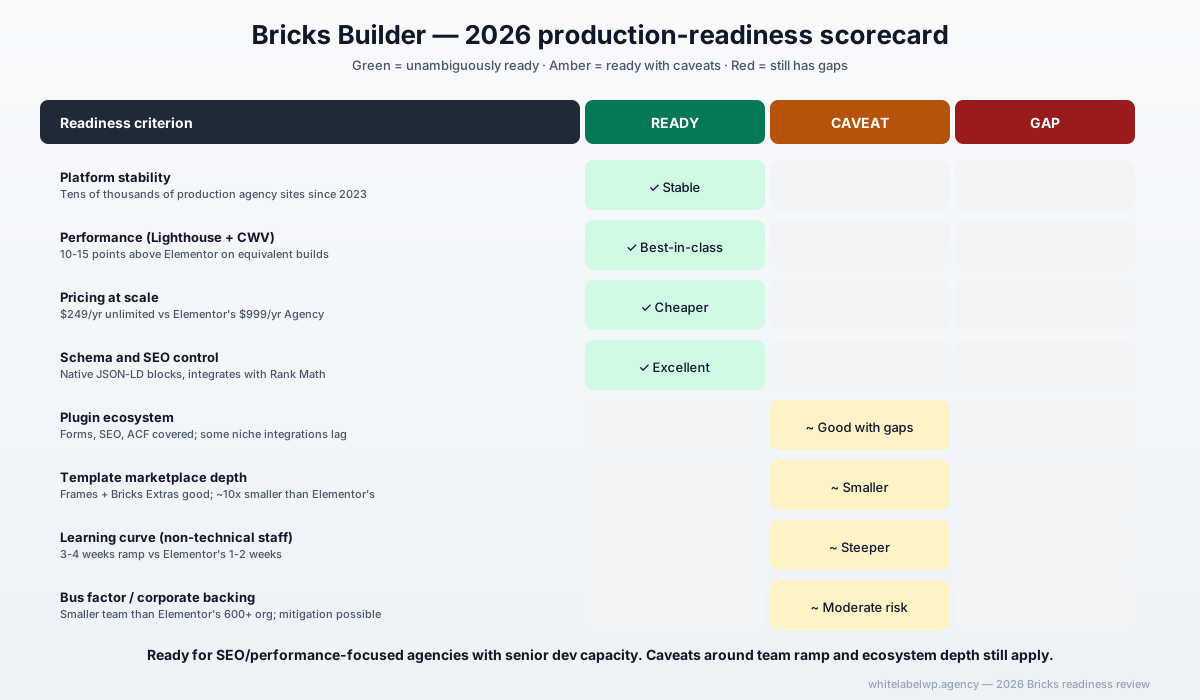
Bricks Builder clears the first criterion unambiguously and largely clears the second. The third and fourth depend on team makeup and client profile.
For a deeper head-to-head with Elementor, see our Elementor vs Bricks Builder comparison. This article is the production-readiness assessment, not the comparison.
Where Bricks is unambiguously ready
Performance and Core Web Vitals
This is the single biggest reason agencies move to Bricks in 2026. On equivalent builds (same design, same content, same hosting), Bricks pages benchmark 10-15 Lighthouse Performance points higher than Elementor and 100-300ms faster on Time to First Byte. The performance edge comes from cleaner front-end markup, no jQuery dependency, and an external-stylesheet approach instead of inline CSS bloat.
For SEO-driven agency clients where Core Web Vitals affect ranking, the performance gap compounds across the portfolio. We’ve seen agencies lift average client Core Web Vitals scores by 8-12 points just from moving the page-builder layer — without changing hosting, design, or content.
SEO and schema control
Bricks’ custom code blocks let you inject JSON-LD schema directly on any page without third-party plugins. Combined with Rank Math, you get schema control at the level Elementor only reaches through additional add-ons. For agencies running structured-data work for clients, this is real operational time saved.
CSS-first architecture
Bricks pairs natively with Automatic.css and Core Framework — design-token systems that let agencies standardize spacing, typography, color, and component primitives across an entire client portfolio. The result: client #20 looks consistent with client #1 without the team manually replicating CSS rules. Elementor can do something similar with custom CSS but the workflow is more manual.
Pricing economics at scale
Bricks at $249/year for unlimited sites versus Elementor Pro Agency at $999/year is a $750/year difference. Across a 30-site portfolio that’s $25/site/year vs Elementor’s $33/site/year. Not the deciding factor for most agencies, but real money that adds up at 50+ sites.
Where Bricks still has gaps in 2026
Template marketplace depth
The Bricks ecosystem grew fast 2023-2026 but the template library is still meaningfully smaller than Elementor’s. Frames is the leading Bricks template marketplace and is genuinely good for the use cases it covers, but Elementor’s Envato + native template library covers roughly 10 times the design patterns.
For agencies that lean heavily on adapting pre-built templates, Bricks adds 20-30% to typical build time. For agencies that build from scratch or from custom design systems, the gap doesn’t matter.
Some plugin integrations
Major plugins integrate with Bricks (Gravity Forms, Fluent Forms, WS Forms, WPForms, ACF Pro, Rank Math, FluentCRM, MailerLite), but the breadth of pre-built Elementor add-ons isn’t matched. HubSpot connectors, some niche CRM integrations, and a handful of WooCommerce extensions either lack Bricks-specific support or require workarounds.
For most agency client work this isn’t blocking. For agencies whose clients depend on specific Elementor-only integrations, the gap can be real.
Team learning curve for non-technical staff
Bricks rewards developer instincts. Junior staff or non-technical content people coming from Elementor’s drag-and-drop model typically need 3-4 weeks of focused practice before they’re shipping production-grade work, versus 1-2 weeks on Elementor. For agencies with mixed-skill teams, that ramp delta is real cost.
Bus-factor and corporate-backing risk
Bricks is built by a smaller team than Elementor’s. The platform has been stable since 2023 and has a paying customer base measured in tens of thousands, so the immediate risk is low. But the bus-factor question — what happens to your portfolio if the company shuts down — sits differently than with corporate-backed Elementor.
The honest mitigation is to keep client code portable: avoid deep Bricks-specific custom widgets where standard ones work, document the build approach so a future migration team can pick it up, and maintain backups outside Bricks’ tooling.
Who Bricks is right for in 2026 (three agency profiles)
Profile 1: The SEO-focused performance agency. Client mix is heavy on content sites, lead-gen funnels, or e-commerce where Core Web Vitals affect ranking and conversion. Has at least one developer comfortable in HTML/CSS and DevTools. Team can absorb a 3-4 week ramp on Bricks-first workflows. For these agencies, Bricks is a clear upgrade.
Profile 2: The agency starting fresh (no Elementor portfolio). New agency or one that’s been building with custom themes or Gutenberg and is now choosing a page-builder stack. No switching cost, no portfolio of Elementor sites to migrate, no muscle memory to retrain. For these agencies, Bricks is the structurally better starting choice in 2026.
Profile 3: The agency rebuilding their stack anyway. Currently on Elementor but planning a stack-wide refresh (new design system, new client onboarding process, new build playbook) for unrelated reasons. The marginal cost of also adopting Bricks during the rebuild is small. For these agencies, Bricks during the refresh window is the right move.
Who should NOT switch to Bricks yet
Three profiles where Elementor remains the right call:
- Mixed-skill team without senior dev capacity. If your team is 60%+ non-technical staff doing builds in a drag-and-drop visual editor, Bricks’ learning curve will absorb dev time you don’t have.
- Client mix is form-and-funnel heavy with Elementor-only integrations. HubSpot deep integrations, specific landing-page builders, and form-heavy lead capture workflows benefit from Elementor’s ecosystem.
- Existing portfolio of 30+ Elementor sites with no commercial reason to migrate. Migration cost (40-80 senior hours per site for rebuilds) doesn’t pay back if the existing sites are performing fine.
Honest assessment beats reflexive platform-switching every time. Many agencies that “should” be on Bricks based on the spreadsheet are better off staying on Elementor because the switching cost exceeds the operational benefit.
The migration math — moving an Elementor portfolio
For agencies considering a portfolio-wide Elementor → Bricks migration:
| Portfolio size | Estimated migration cost (white-label) | Annual savings (license) | Payback period |
|---|---|---|---|
| 10 sites | $20,000-$40,000 | $750 | 27-53 years |
| 30 sites | $60,000-$120,000 | $750 | 80-160 years |
| 50 sites | $100,000-$200,000 | $750 | 133-266 years |
License savings alone never justify migration. What does justify it: performance improvements compounding into measurable ranking gains, better build economics on new projects post-migration, or a stack-rebuild project that was happening anyway.
For agencies migrating one or two flagship client sites to Bricks to test the workflow, the math is different — call it $2,000-$4,000 white-label cost per site, payback driven by client-specific outcomes (ranking, conversion, performance) rather than license savings.
How White Label WP Agency works in Bricks
We’ve shipped 200+ Bricks builds across agency partners as of 2026. The Bricks-specific execution plugs into our standard partnership rhythm — brief intake, staging build, QA, delivery, care — the same way Elementor or Divi work does. What changes is the technical layer, not the operational one.
For agencies actively choosing or testing Bricks for their stack, our page-builder development service documents the scope. Our builds service covers new Bricks projects. Pro and Max retainers absorb both new builds and care plans on Bricks sites alongside Elementor sites.
If your agency is at the decision point on Bricks adoption, book a partner call. We’ll walk through your client mix, team makeup, and existing portfolio honestly. If the math says stay on Elementor, that’s what we’ll recommend.
Frequently asked questions
Is Bricks Builder ready for production agency use in 2026?
Yes for agencies with at least one developer comfortable in HTML/CSS and a client mix where performance matters. Bricks has matured significantly since 2023 — it’s stable, the ecosystem has filled out with Frames, Bricks Extras, Automatic.css, and Core Framework, and it’s now used in production on tens of thousands of agency sites. The “ready” caveats are about team fit, not platform maturity.
How does Bricks Builder compare to Elementor in 2026?
Bricks wins on performance (10-15 Lighthouse points higher on average), pricing at scale ($249/year unlimited vs Elementor’s $999/year Agency), and schema control. Elementor wins on template marketplace, third-party plugin ecosystem, and team ramp speed for non-technical staff. The choice depends on which set of strengths matches your client mix. Our deeper comparison is in the Elementor vs Bricks article.
How long does it take an agency team to ramp up on Bricks Builder?
For developers comfortable with HTML/CSS, 1-2 weeks to production-grade. For non-technical staff coming from Elementor, plan 3-4 weeks of practice on real (or sandbox) projects before they’re shipping client work confidently. The learning curve isn’t conceptual — it’s about Bricks’ more code-adjacent UI patterns that reward developer instincts.
What plugins are essential for Bricks Builder agency work?
Beyond Bricks itself, the typical agency stack adds Frames (template library), Bricks Extras (additional widgets), Automatic.css or Core Framework (design tokens), Rank Math (SEO), and Migrate Guru or All-in-One WP Migration (deployment). Total annual cost: $400-$600/year for an unlimited-site agency setup. That’s $750/year cheaper than Elementor Pro Agency at equivalent feature parity.
Can a Bricks site be migrated to Elementor if we need to switch back?
Yes, but not automatically. There’s no Bricks-to-Elementor migration plugin equivalent to the Elementor-to-Bricks tool. Migration is manual rebuild, which usually costs 40-60% of a fresh build. The honest reality: most agencies that adopt Bricks don’t switch back because the performance advantage compounds. But if your strategy demands optionality, factor that 40-60% rebuild cost into your decision.
Is there bus-factor risk in adopting Bricks Builder for an agency portfolio?
Moderate. Bricks is built by a smaller team compared to Elementor’s 600+ person organization. The platform has been stable since 2023, has paying customer base in tens of thousands, and shows no signs of distress. But the bus-factor risk is real — if Bricks shut down, agencies on the platform would face a structural rebuild problem within 12-18 months. Mitigate by keeping client code portable and avoiding deep Bricks-specific custom widgets where standard ones suffice.
Can a white-label developer build agency sites in Bricks Builder?
Yes — White Label WP Agency builds in Bricks for agencies that have standardized on it. We’ve shipped 200+ Bricks builds across agency partners as of 2026. The Bricks-specific workflow plugs into our standard process (brief intake, staging build, QA, delivery) the same way Elementor or Divi work does — what changes is the technical execution layer, not the partnership rhythm.