The White Label NDA: What Should Actually Be in It (Template)
What a white-label WordPress NDA must cover — five sections, real template structure, and the clauses agencies miss most often.
The White Label NDA: What Should Actually Be in It (Template)
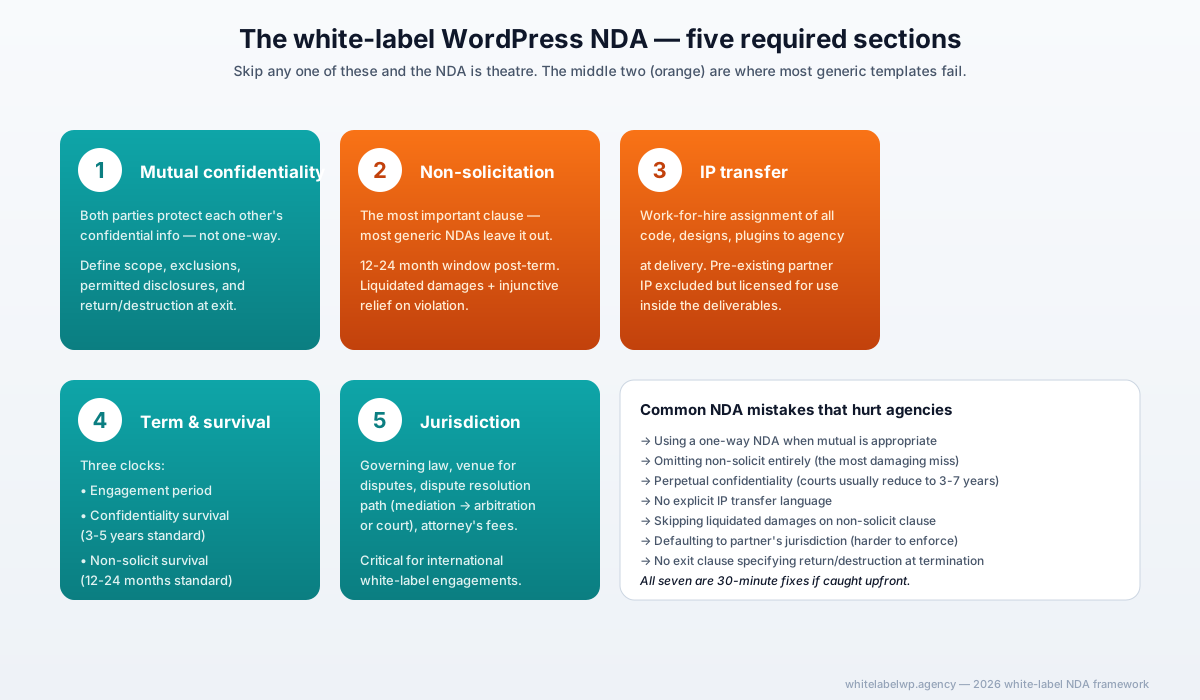
A white-label WordPress NDA needs to do five things: cover both parties’ confidentiality obligations mutually, explicitly prohibit the partner from naming or contacting the agency’s end clients, specify code-ownership transfer at delivery, define how long obligations persist after the partnership ends (typically 3-5 years), and name the governing jurisdiction and dispute resolution path. Skip any of those and the NDA is theatre — a piece of paper that doesn’t actually protect the agency relationship it’s supposed to.
Quick note: this article is informational, not legal advice. Treat the structure below as a starting framework, then have an attorney in your jurisdiction review the final document before anyone signs.
What a white-label NDA needs to do
A standard “confidentiality only” NDA was written for situations where two parties exchange one round of sensitive information and walk away. White-label WordPress engagements aren’t like that. The partner sees the agency’s client list, internal pricing, project pipeline, design files, brand assets, and sometimes the strategic roadmap. That confidential exposure is continuous, not one-off.
The five jobs a white-label NDA must do, in order of how often agencies get them wrong:
- Cover both parties. Mutual confidentiality, not one-way.
- Block solicitation of end clients. The partner cannot contact, market to, or pitch the agency’s clients during or after the engagement.
- Transfer code and IP at delivery. Everything the partner builds becomes the agency’s property the moment it ships.
- Define when obligations end. Confidentiality, non-solicit, and IP terms each have their own clock.
- Name the legal jurisdiction. Whose courts, whose laws, what dispute path.
Most generic NDA templates handle #1 and #4 but miss or weaken #2, #3, and #5. Those misses are where agencies get burned.
The five sections every white-label WordPress NDA should have
1. Mutual confidentiality
A white-label engagement isn’t one-way. The agency shares clients, projects, and internal pricing. The partner shares processes, methodology, internal tooling, and sometimes pricing for other clients. Both directions need protection.
What the clause must cover:
- Definition of “Confidential Information” — broad enough to include verbal disclosures, written materials, code, and inferences drawn from disclosed information
- Specific exclusions — information that becomes public independently, was already known before the engagement, or is independently developed
- Permitted disclosures — to the receiving party’s employees and subcontractors who need-to-know, under the same confidentiality obligations
- Return or destruction of confidential information at termination, with a written certification
What the clause should NOT do:
- Make the obligation perpetual without exception. Even trade-secret-grade information typically gets a 5-year or 7-year cap in court
- Make confidentiality so broad it covers genuinely public information (this gets the whole clause thrown out as overreach)
2. Non-solicitation of end clients
This is the single most important clause for white-label work. Without it, nothing in standard confidentiality law prevents the partner from contacting the agency’s clients directly the day the engagement ends.
Required components:
- Window — typically 12-24 months post-termination. Anything under 12 months is too short; anything over 24 months is increasingly hard to enforce in court.
- Scope — covers any individual or company introduced to the partner during the engagement, plus any prospect named in pipeline discussions.
- Definition of “solicitation” — direct outreach, indirect outreach via third parties, marketing campaigns that knowingly target the named accounts, and active recruiting.
- Remedy — liquidated damages (a pre-agreed dollar amount per violation) plus the right to seek injunctive relief. Pure money damages are hard to enforce after the fact; injunctions stop the behavior.
What this clause does NOT do — and shouldn’t try to do — is prevent the partner from working with similar industries, similar-sized agencies, or competitors. That’s a non-compete, not a non-solicit, and non-competes for vendors are usually unenforceable.
3. IP ownership and code transfer
Most generic NDAs miss this entirely. Without explicit transfer language, the partner who wrote the code technically retains copyright on it — even if they were paid to build it. That creates real problems when the agency wants to resell, modify, or migrate the deliverables later.
The clause should state:
- All code, designs, custom plugins, scripts, configurations, and documentation produced under the engagement are work-for-hire, owned by the agency from the moment of delivery
- The partner assigns, irrevocably and without further consideration, any and all rights they may have in the deliverables
- Pre-existing IP (the partner’s internal tooling, frameworks, or templates) remains the partner’s, but the partner grants the agency a perpetual, royalty-free license to use it as embedded in delivered code
- Open-source dependencies follow their respective licenses (this is a clarification, not a limitation)
Without this language, the agency owns the deliverable in commercial terms (they bought it) but doesn’t own the copyright (the partner wrote it). The gap creates licensing ambiguity that surfaces when the agency wants to do something the partner didn’t anticipate.
4. Term and survival
Three clocks run in a white-label NDA, and they’re often different:
- The engagement period. When the active partnership starts and ends.
- Confidentiality survival. How long after the engagement ends the partner must still keep information confidential. Standard is 3-5 years.
- Non-solicit survival. How long the partner cannot solicit end clients. Standard is 12-24 months.
Spell out each clock explicitly. A common mistake is writing “this agreement survives termination” without specifying for how long, which creates ambiguity that defaults to whatever the local jurisdiction interprets as “reasonable” — usually 2 years, often less.
IP transfer is irrevocable — once code is delivered, ownership passes permanently. That clause doesn’t expire.
5. Jurisdiction and dispute resolution
Where will disputes be resolved, under whose laws, and through what process? The clause must name:
- Governing law — usually the jurisdiction where the agency is based, since the agency is the disclosing party with more at stake
- Venue for disputes — typically the same jurisdiction, or a named arbitration forum
- Dispute resolution path — mediation first, then arbitration or court (some agreements require mediation before any litigation)
- Attorney’s fees clause — typically “loser pays” to discourage frivolous disputes
For international partnerships, this section gets more complicated. A US agency working with an India-based partner needs to consider whether to use US law and US courts (better for the agency, harder to enforce against the partner), India law and Indian courts (easier to enforce, less familiar for the agency), or arbitration under international rules (neutral, but more expensive).
Common NDA mistakes that hurt agencies
After running 800+ white-label engagements, the same NDA mistakes show up:
- Using a one-way NDA when a mutual is appropriate. Signals the agency doesn’t understand the relationship is reciprocal.
- Omitting non-solicit entirely. The most damaging mistake. We’ve seen partners pitch agency clients within weeks of an engagement ending because no non-solicit clause existed.
- Perpetual confidentiality obligations. Courts usually reduce these to 3-7 years, so writing “in perpetuity” wastes ink and signals legal inexperience to the partner.
- No explicit IP transfer. Agency owns the project commercially but doesn’t own the code legally. Surfaces years later as a problem.
- Skipping liquidated damages on non-solicit. Pure money damages are hard to prove. Liquidated damages ($25,000-$100,000 per violation is typical) are pre-agreed and enforceable.
- Naming the wrong jurisdiction. Defaulting to the partner’s jurisdiction makes enforcement harder for the agency.
- No exit clause. What happens to confidential information at termination — return, destroy, or retain? Write it down.
One-way vs mutual NDAs — which to use when
Use a one-way NDA when:
- A consultant or contractor is being briefed on a single discrete project with no return information flowing
- The engagement is short (under 60 days) with limited confidential exchange
- The recipient is a vendor (e.g., a translator, a stock photo licensor) whose operations don’t generate sensitive return data
Use a mutual NDA when:
- The relationship is ongoing or recurring (any retainer-based partnership)
- Both parties exchange confidential information (always true of white-label WordPress)
- The partnership will involve discussions of pipeline, pricing, methodology, or strategy
- Either party will see operational details of the other
For white-label WordPress engagements, mutual is the default. A partner that pushes for one-way (protecting only their information, not the agency’s) is signaling they don’t intend to reciprocate the obligations they expect.
Template structure (copy + adapt)
A workable starting structure for a white-label WordPress NDA:
WHITE-LABEL WORDPRESS CONFIDENTIALITY AND NON-SOLICITATION AGREEMENT

Between: [Agency name, address, jurisdiction] ("Agency")
And:     [Partner name, address, jurisdiction] ("Partner")
Effective Date: [YYYY-MM-DD]

1. CONFIDENTIAL INFORMATION
   1.1 Definition (mutual, broad scope)
   1.2 Exclusions (already public, independently developed, lawfully received)
   1.3 Standard of care (same care as own confidential information, not less than reasonable)

2. NON-SOLICITATION
   2.1 Definition of "Protected Clients" (named list + future introductions)
   2.2 Solicitation prohibition (direct + indirect)
   2.3 Window: 18 months post-termination
   2.4 Liquidated damages: $[amount] per violation
   2.5 Injunctive relief in addition to damages

3. INTELLECTUAL PROPERTY
   3.1 Work-for-hire assignment of all deliverables to Agency
   3.2 Partner pre-existing IP excluded but licensed for use in deliverables
   3.3 Open-source components governed by their respective licenses
   3.4 Moral rights waived to extent permitted by law

4. TERM AND SURVIVAL
   4.1 Engagement period: [start date] until terminated by either party with [30] days written notice
   4.2 Confidentiality obligations survive 5 years post-termination
   4.3 Non-solicit obligations survive 18 months post-termination
   4.4 IP transfer is permanent

5. JURISDICTION AND DISPUTE RESOLUTION
   5.1 Governing law: laws of [State/Country], without regard to conflict of law principles
   5.2 Venue: courts of [city/state]
   5.3 Mandatory mediation before litigation
   5.4 Attorney's fees: prevailing party recovers reasonable fees and costs

6. MISCELLANEOUS
   6.1 Entire agreement
   6.2 Modification only by written amendment
   6.3 Severability
   6.4 Counterparts and electronic signature

Signed: [Agency authorized signer]   Date: ____
Signed: [Partner authorized signer]  Date: ____
This is a starting point, not a finished contract. Take it to an attorney in the agency’s jurisdiction before anyone signs.
What an NDA can’t protect
An NDA is a strong tool, but it has limits worth naming:
- It can’t prevent the partner from getting better at their craft. Knowledge of WordPress, WooCommerce, and general delivery patterns learned during the engagement is the partner’s, period.
- It can’t enforce itself. Violations require the agency to detect them, pay attorneys to investigate, and pursue remedies. Build operational tripwires (Slack monitoring of competitor pitches, periodic check-ins with end clients) so violations are caught fast.
- It can’t prevent honest disagreements. What counts as “confidential” gets disputed in real engagements. The clearer the definition in the NDA, the less argument later.
- It can’t replace good vendor selection. A bad partner with a great NDA is still a bad partner. The agreement reduces risk; it doesn’t eliminate it.
For complex engagements involving custom IP, ongoing royalties, or shared platforms, the NDA often gets bundled into a Master Services Agreement (MSA) that includes payment terms, deliverable acceptance criteria, warranty terms, and other commercial structure.
When to escalate to an MSA
A standalone NDA covers confidentiality and IP. An MSA covers everything else: payment schedules, change orders, deliverable acceptance, warranty terms, liability caps, insurance requirements, and termination clauses for commercial breach (not just confidentiality breach).
For most white-label WordPress retainers, an MSA is overkill in the first 30-60 days — the engagement is small and a strong NDA plus the partner’s standard terms of service usually suffices. Once the partnership is steady-state and represents meaningful agency revenue (typically $50K+ annually paid to the partner), an MSA becomes worth the legal cost.
The trigger questions for moving from NDA-only to MSA-plus:
- Is the partner being paid more than $30K/year by the agency?
- Are end-client SLAs being passed through the partnership?
- Are there custom IP arrangements beyond standard work-for-hire?
- Is the engagement multi-year with auto-renewal?
Yes to two of those → consider an MSA.
How White Label WP Agency handles NDAs
We sign a mutual NDA before any discovery conversation. Our standard NDA covers all five sections in this article, including the non-solicit clause many partners try to leave out. We accept reasonable redlines but won’t sign a one-way NDA — the partnership only works if both parties are protected.
Code ownership transfers to the agency at delivery on every project, written into the engagement contract. End-client information stays inside the agency’s brand boundary; we never appear in client communications, emails, or invoices.
If you’re evaluating partners and want to see how we structure the legal layer, book a partner call — we’ll walk through our standard NDA framework and answer specific questions. For broader context on partnership economics, our build service and care plans describe the operational side that lives alongside the legal layer.
Frequently asked questions
Do white-label WordPress agencies sign NDAs?
Yes — any credible white-label WordPress partner signs a mutual NDA before any kickoff conversation. The NDA protects the agency’s client list, project details, internal pricing, and proprietary processes. If a prospective partner balks at signing an NDA before discovery, that’s a red flag — the entire white-label model depends on confidentiality, and an unwilling partner won’t reliably keep the relationship invisible.
What’s the difference between a one-way and mutual NDA in white-label work?
A one-way NDA protects only one party’s information (typically the agency disclosing client details to the partner). A mutual NDA protects both parties — the agency’s confidential information and the partner’s processes, pricing, and methodology. For white-label WordPress partnerships, mutual NDAs are the standard because both sides exchange confidential information. One-way NDAs are appropriate for brief consulting engagements where only one party is sharing sensitive data.
How long should a white-label NDA’s confidentiality obligation last?
3-5 years post-termination is the industry standard for white-label WordPress NDAs. Some agencies push for perpetual obligations on trade-secret information (client lists, pricing) while accepting 3 years on general project information. Avoid anything under 2 years — too short to meaningfully protect a multi-year client relationship — or anything over 7 years, which usually gets reduced in court if challenged.
Should the NDA cover non-solicitation of the agency’s end clients?
Yes — this is the single most important clause for white-label work. Without an explicit non-solicit, nothing in standard confidentiality law prevents the partner from contacting the agency’s clients directly after the engagement ends. The clause should specify a 12-24 month non-solicit window post-termination, name “any individual or company introduced to the partner during the engagement,” and include liquidated damages or specific performance remedies.
Does the NDA need to specify code ownership and IP transfer?
Yes, and most generic NDAs miss this. The NDA (or an attached IP assignment clause) should state that all code, designs, custom plugins, and deliverables produced under the engagement are work-for-hire owned by the agency from the moment of delivery — not by the partner who built them. Without this clause, the partner technically retains copyright on code they wrote, which creates ambiguity if the agency later resells or modifies the deliverables.
What if my agency already has a standard contractor agreement — do I still need a separate NDA?
Usually no — most agency contractor agreements include confidentiality, non-solicitation, and IP transfer clauses already. The question is whether those clauses are strong enough for white-label specifically. Review the existing agreement against the five jobs in this article. If it covers all five, no separate NDA needed. If it misses non-solicit or IP transfer, add a one-page rider rather than negotiating a new agreement from scratch.
Can a white-label partner negotiate the NDA terms before signing?
Yes, and they should. A partner that signs any NDA without redlining usually isn’t paying attention — credible partners push back on overly broad indemnification, perpetual obligations, or one-sided IP terms. Expect 2-3 rounds of redlines on the first NDA with a new partner. Subsequent engagements with the same partner usually go faster because the framework is already negotiated.