The 90-Day Partner Test: How to Evaluate a White Label WordPress Agency
How to evaluate a white-label WordPress partner in 90 days. 12 metrics across 4 dimensions, 4 deal-breakers, and a structured trial framework.
The 90-Day Partner Test: How to Evaluate a White Label WordPress Agency
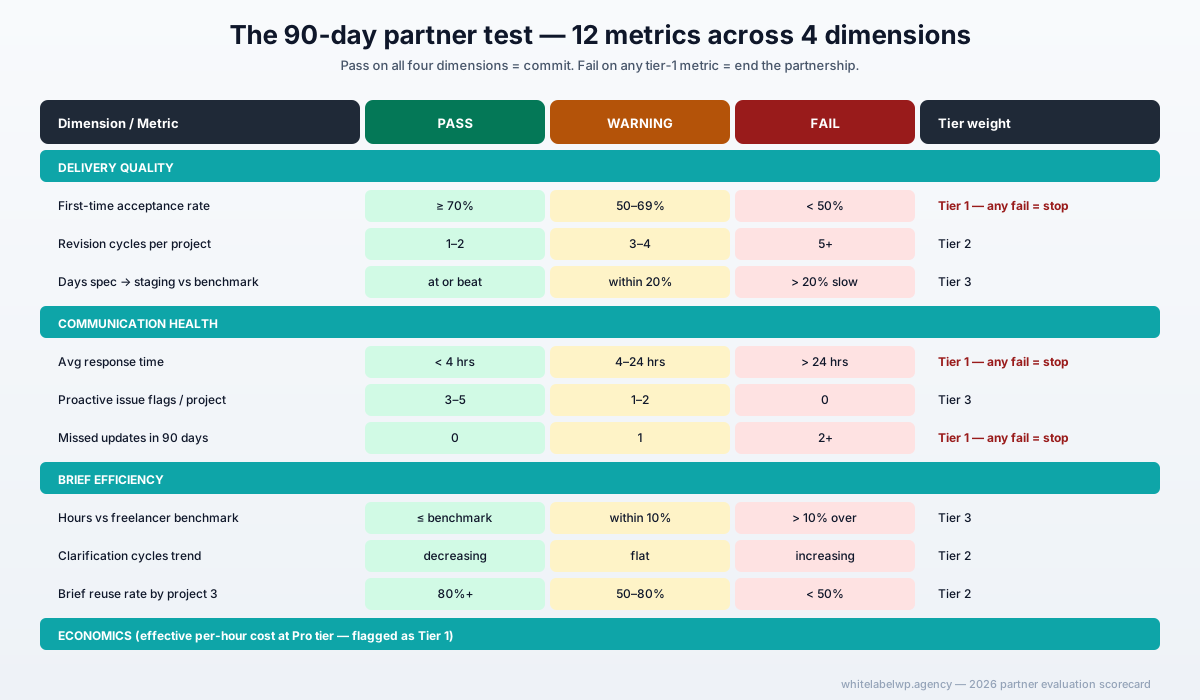
The 90-day partner test for a white-label WordPress agency is three trial cycles measuring four things: delivery quality (does the work meet acceptance criteria first time), communication health (response time, clarity, proactive flagging), brief efficiency (does the partner reduce or increase clarification overhead), and economics (is the effective per-hour cost trending favorable). Pass on all four = commit. Fail on any one = either renegotiate scope or unwind cleanly before the partnership compounds.
The framing matters: 90 days is short enough to walk away without sunk-cost regret, long enough to see how the partner handles the second-month dip in novelty and the third-month real-world stress.
Why 90 days, not 30 or 180
A 30-day trial captures one project cycle. One cycle is mostly first-impression performance — both parties on best behavior, novelty effort high, real-world friction not yet surfaced. The data is biased.
A 180-day trial captures real-world performance accurately but creates a different problem: by month six, the agency has absorbed too much switching cost. Briefs are formatted to the partner’s preferences, the partner has all the credentials, end clients have started seeing the work. Walking away clean gets harder every week past day 90.
90 days is the sweet spot:
- Three full project cycles (or one larger project plus two cycles of care/iteration)
- Long enough to see month-two dip and month-three stress
- Short enough that exit is operationally clean — credentials handed back, briefs reformatted, freelancer rolodex still warm
In our experience working with 150+ agency partners, the partnerships that survive year one almost always show clean signals by day 60 and confirmation by day 90. The partnerships that fail later usually had warning signs visible in the first 90 days that the agency chose to push past.
The four dimensions to test
1. Delivery quality
The most important dimension. Three metrics:
- First-time acceptance rate. Of all deliverables in the trial window, what percent passed the agency’s acceptance criteria without revision? Below 50% is a fail. 50-70% is warning territory — probably brief problems that need fixing on the agency side. Above 70% is passing.
- Revision cycles per project. Average number of agency feedback rounds before final delivery. 1-2 is healthy; 3-4 means the brief or the dev is weak; 5+ means the partnership has a structural problem.
- Days from spec to staging. How long from the agency handing over a finalized brief to a staging-ready build. Compare against the agency’s existing freelancer benchmark — partners should match or beat it within 60 days of starting.
2. Communication health
How the partner shows up in the channel matters as much as the code they ship. Three metrics:
- Average response time on Slack/email. Business hours, weekday averages. Under 4 hours is excellent; under 24 hours is acceptable; over 48 hours is failing for a paid partnership.
- Proactive issue flags. Count of times the partner flagged a delay, blocker, or scope creep before the agency had to ask. A partner that flags 3-5 issues per project is healthy; a partner that flags zero is either hiding problems or genuinely has none (rare).
- Missed updates. Count of scheduled check-ins or status reports the partner missed without notice. More than one in 90 days is a structural issue.
3. Brief efficiency
A good partner reduces the agency’s brief overhead over time. A bad one increases it. Three metrics:
- Hours per project vs freelancer benchmark. Total partner hours invoiced for comparable projects vs what a freelancer would have charged. Partners should match within month 1, beat within month 2-3.
- Clarification cycles per project. Count of “I need more info before I start” emails or Slack messages per project. Should trend down month-over-month as the partner learns the agency’s standards.
- Brief reuse rate. What percent of the agency’s brief format from project 1 carries over to project 3 without rework. High reuse means the partner is learning; low reuse means each project starts from scratch operationally.
4. Economics
The hardest dimension to measure but the most important long-term. Three metrics:
- Effective per-hour cost. Total cost divided by total dev hours. At Pro retainer level, this should be $18-$25/hour effective. Below $18 is suspiciously cheap (quality risk); above $25 is creeping toward freelancer rates.
- Margin earned on agency’s resale. What the agency bills clients vs what the partner costs. Standard agency markup is 2x; partnerships that don’t support 2x markup are too expensive at the per-hour rate.
- Billable hours utilization. Of the hours included in the retainer, what percent did the agency actually use. Below 70% means the retainer is oversized; 70-90% is healthy; 90-100% means the agency should upgrade to the next tier.
Month 1 — Single trial project
Pick one well-defined project. Not the agency’s most complex client, not the most boring — something average in scope (a 15-20 page WordPress build, a moderate-complexity care plan migration, or a defined custom plugin task).
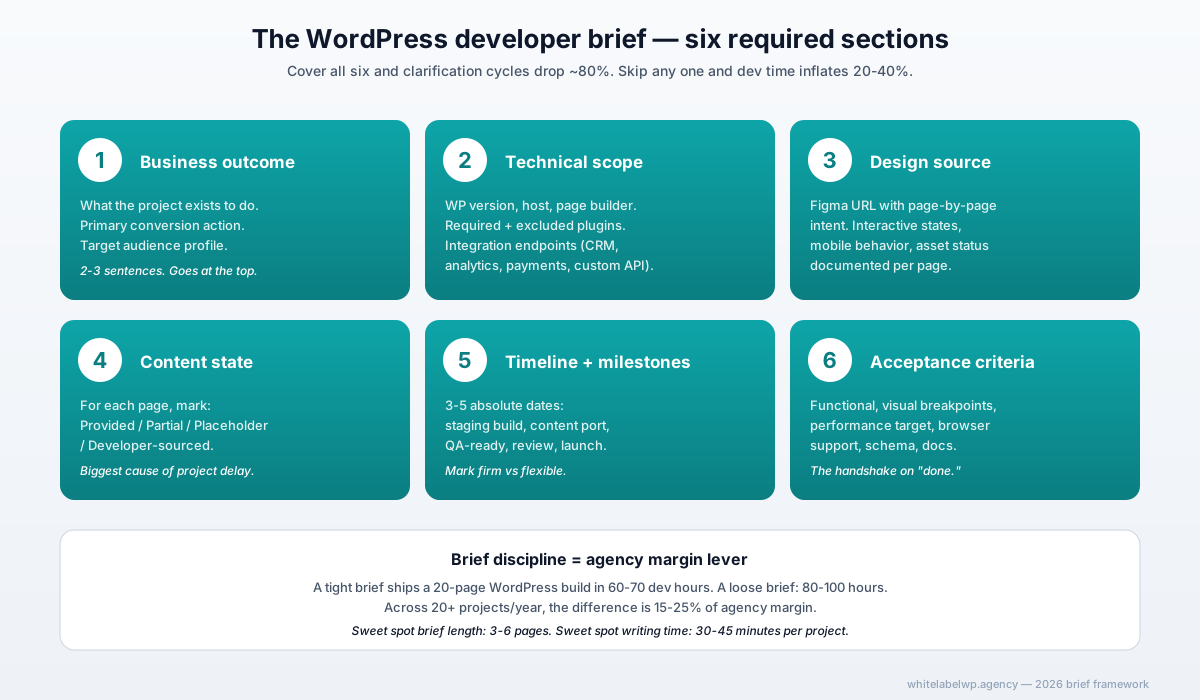
Brief the partner using the full structure from our briefing guide. Make the brief deliberately tight. The goal of month 1 is to set the bar for how briefs work, then measure delivery against that bar.
End of month 1 check-in (30 minutes):
- Walk through the four dimensions
- Share the first-month metrics openly (don’t hide weak numbers)
- Identify two things the partner does well, two things to improve
- Confirm the partner is bought into the 90-day trial framing
If month 1 is a clear fail (acceptance rate below 30%, response time over 48 hours, project missed deadline by more than 20%), end the trial here. Don’t push through hoping it improves.
Month 2 — Steady-state cadence
Run two simultaneous projects. Different shapes — one build and one care plan task, or one new client and one existing client retention. The point is to test how the partner handles parallel work without compromising on either.
By end of month 2:
- The partner should know the agency’s brief format and standards
- Clarification cycles should be measurably lower than month 1
- The partner should be flagging issues proactively, not reactively
- Communication cadence should feel like a working partnership, not a vendor relationship
Month 2 check-in: harder questions. Has the partner introduced any unprompted improvements? Suggested better tooling, flagged a security issue, recommended a hosting change? Partners that only execute the brief verbatim are working; partners that contribute strategic value are growing.
Month 3 — Decision pressure test
Three things to test in month 3:
-
Scope change handling. Deliberately introduce a mid-project scope change (something legitimate, not a manufactured test). How does the partner handle it? A written change order within 24 hours, a re-quote, clean execution = pass. Slack-message handling, no re-quote, scope creep absorbed reluctantly = fail.
-
Stress moment. A real one if available, or simulated otherwise. A missed client deadline, an emergency fix needed, a scope blow-up. How does the partner respond under stress? Calm, proactive, transparent = pass. Defensive, slow, blame-shifting = fail.
-
Forward planning. Ask the partner what they’d do for the agency in months 4-12 if the partnership continues. A partner with a real answer (specific recommendations, specific outcomes, specific operational adjustments) is bought in. A partner with a generic “happy to keep going” is transactional.
End of month 3 = the commit decision.
The 12-metric scorecard
| Dimension | Metric | Pass | Warning | Fail |
|---|---|---|---|---|
| Delivery quality | First-time acceptance rate | ≥70% | 50-69% | <50% |
| Delivery quality | Revision cycles per project | 1-2 | 3-4 | 5+ |
| Delivery quality | Days spec → staging vs benchmark | At or beat | Within 20% | >20% slow |
| Communication | Avg response time | <4 hrs | 4-24 hrs | >24 hrs |
| Communication | Proactive issue flags | 3-5/project | 1-2/project | 0/project |
| Communication | Missed updates in 90 days | 0 | 1 | 2+ |
| Brief efficiency | Hours vs freelancer benchmark | ≤ benchmark | Within 10% | >10% over |
| Brief efficiency | Clarification cycles trend | Decreasing | Flat | Increasing |
| Brief efficiency | Brief reuse rate by project 3 | 80%+ | 50-80% | <50% |
| Economics | Effective per-hour cost (Pro tier) | $18-$25 | $25-$30 | <$18 or >$30 |
| Economics | Supports 2x agency markup | Yes | Tight | No |
| Economics | Retainer hour utilization | 70-90% | <70% or >100% | <50% |
How to read the results
The 12-metric scorecard isn’t a simple average. Different metrics carry different weight:
Tier 1 metrics (any fail = end the partnership):
– First-time acceptance rate
– Response time
– Missed updates
– Effective per-hour cost
Tier 2 metrics (one warning is fine, two failures = renegotiate):
– Revision cycles
– Clarification cycles trend
– Brief reuse rate
– Margin support
Tier 3 metrics (informational, used for tier selection and ongoing optimization):
– Days to staging
– Proactive flags
– Hours vs benchmark
– Utilization rate
A passing partner shows all green or near-green on tier 1, mostly green on tier 2, and trending up on tier 3.
The four deal-breakers
Four things are immediate red flags during the trial. Any one of these means the partnership won’t survive year one regardless of how the rest of the scorecard reads:
- Missing a launch date with no proactive flag in the preceding 48 hours. Surprised agencies churn relationships. A partner that doesn’t flag risk early can’t be trusted with client-facing work.
- Shipping work that fails acceptance criteria the agency has communicated in writing. Either the partner isn’t reading the brief or doesn’t care about the standard. Both are unfixable.
- Going silent on a Slack channel for more than 3 business days without explanation. Communication is the foundation of remote partnership. A silent partner is a partnership in slow collapse.
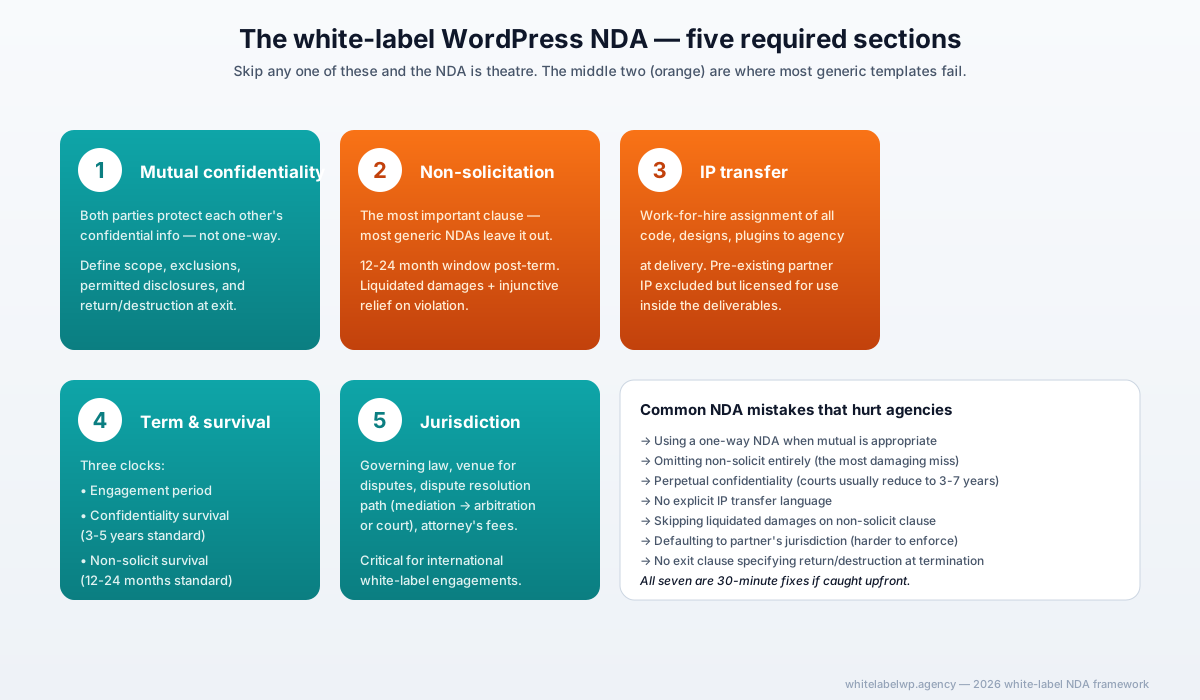
- Pitching the agency’s end clients in any form — direct outreach, indirect marketing targeting, recruiting attempts. Every white-label NDA covers this; violation means immediate termination with no second chance.
Any of these in the trial window = walk away. Don’t talk yourself into believing it will get better. It doesn’t.
When to extend the trial vs cut bait
Sometimes the scorecard reads “warning” across multiple metrics but no outright fails or deal-breakers. The question becomes: extend the trial 30-60 days for clearer data, or cut now?
Extend if:
- The partner is showing month-over-month improvement on weak metrics
- The agency’s brief discipline has been the bottleneck and is being fixed
- The scope of the trial projects has been atypical of the agency’s real pipeline
Cut bait if:
- Warnings are flat or worsening over 90 days
- The partner has missed two proactive-flag opportunities
- The agency’s gut sense after three months is “this still feels like work”
- A better candidate is in the pipeline
Trust the scorecard over instinct, but don’t ignore instinct when it consistently agrees with mediocre numbers.
How White Label WP Agency structures the trial
We structure the first 90 days as three project-priced engagements before any retainer commitment. Each project has clear acceptance criteria, fixed pricing, and explicit success metrics. We schedule a 30-minute review at the end of months 1, 2, and 3 to walk through the metrics openly.
If at any point during the trial the agency wants to walk away cleanly, the project terminates at the next deliverable with full code handover, credential transfer, and a one-page summary of what was built. No retainer minimum to unwind, no recurring billing to cancel.
The transition into a Pro retainer at $1,099/month or Max at $1,999/month happens after the 90-day review, only if both parties want it. Partners that pass the scorecard typically convert; partners that don’t, don’t — and the trial structure makes the unwind clean for both sides.
For agencies in active vendor evaluation right now, our build service describes the operational side and our about page covers the founder context. Book a partner call to scope a single trial project as the first step of a 90-day evaluation.
Frequently asked questions
Why 90 days and not 30 for a white-label WordPress partner trial?
30 days only captures one delivery cycle, which is biased toward first-engagement excitement (both sides on best behavior). 90 days captures three full cycles, which is enough to see how the partner handles the second-month dip in novelty and the third-month real-world stress (scope changes, missed dates, client escalations). Below 60 days the data is noise; above 180 days the agency has already absorbed too much switching cost to walk away cleanly.
What KPIs should I track during a white-label WordPress partner trial?
Twelve metrics across four dimensions: delivery quality (first-time acceptance rate, revision cycles per project, days from spec to staging), communication health (avg response time on Slack/email, proactive issue flags, missed updates), brief efficiency (hours per project vs comparable freelancer benchmark, clarification cycles, brief reuse rate), and economics (effective per-hour cost, margin earned on agency’s resale, billable hours utilization vs paid hours).
What does a “pass” look like at the 90-day mark?
A passing partner ships every trial project within 10% of the agreed timeline, achieves first-time acceptance on 70%+ of deliverables, responds to messages within 24 business hours, flags issues proactively before they become escalations, reduces clarification cycles month-over-month, and delivers effective per-hour cost at or below the agency’s freelancer benchmark. Two-thirds of partners that pass these criteria become 2+ year partnerships.
What’s a deal-breaker during the trial?
Four things are immediate red flags: missing a launch date with no proactive flag in the preceding 48 hours, shipping work that fails acceptance criteria the agency has communicated in writing, going silent on a Slack channel for more than 3 business days without explanation, or pitching the agency’s end clients in any form. Any one of these in the trial window means the partnership won’t survive year one.
Should I tell the partner I’m in a 90-day trial?
Yes — explicitly. A partner that knows they’re on a trial typically performs better, and they appreciate the structure. Frame it as “we’re doing three trial projects to evaluate fit, with the goal of moving to a Pro retainer at end of Q1 if both sides are happy.” That’s professional, not threatening. Partners that react badly to this framing are usually the ones that would have failed anyway.
How does White Label WP Agency handle trial partnerships?
We structure the first 90 days as three project-priced engagements before any retainer commitment. Each project has clear acceptance criteria, fixed pricing, and explicit success metrics. We schedule a 30-minute review at the end of months 1, 2, and 3. If at any point the agency wants to walk away cleanly, the project terminates at the next deliverable with full code handover. The transition into a Pro or Max retainer happens after the 90-day review, only if both parties want it.