White Label WordPress for Healthcare, Legal, and Finance Agency Clients
How agencies handle white-label WordPress for healthcare, legal, and finance clients. HIPAA, accessibility, audit trails, and compliance-aware partnerships.
White Label WordPress for Healthcare, Legal, and Finance Agency Clients
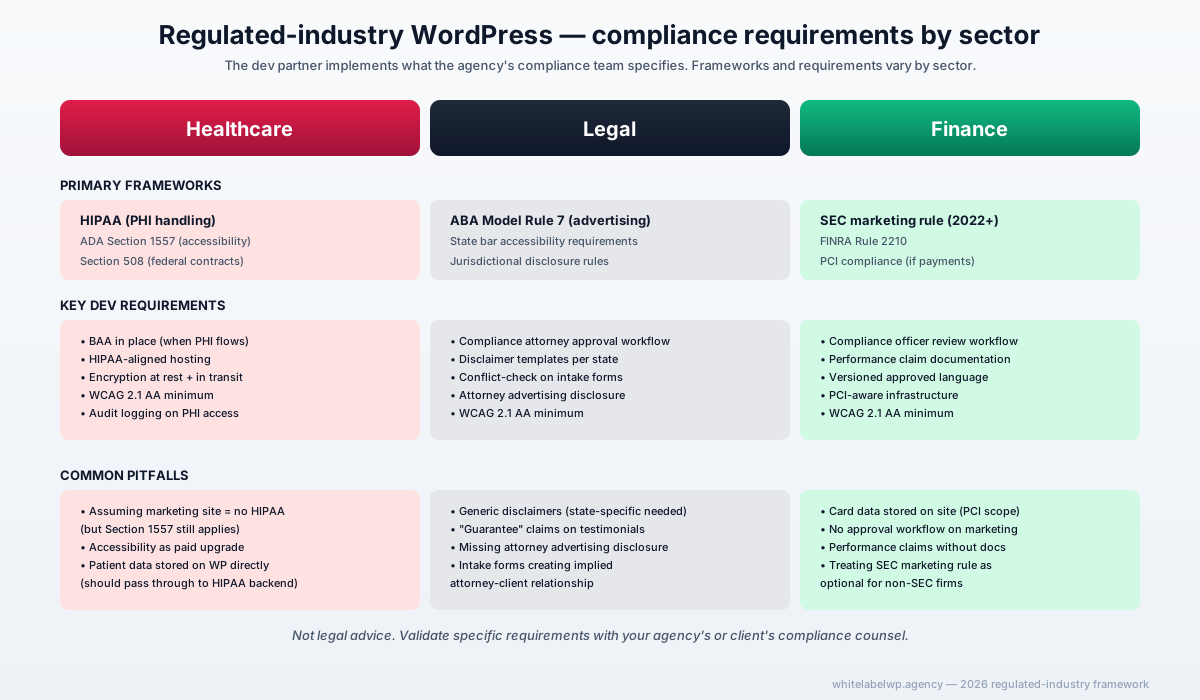
A white-label WordPress partner working with regulated-industry clients — healthcare, legal, finance — needs four operational disciplines that general-agency partners often lack: documented compliance framework familiarity (HIPAA for healthcare, ABA model rules for legal, SEC/FINRA-aligned for finance), accessibility implementation at WCAG 2.1 AA minimum, audit-trail-ready development practices, and data handling architecture that respects the client’s compliance posture. Partners without all four create compliance exposure the agency absorbs.
Quick note: this article describes operational disciplines a dev partner needs, not legal or compliance advice. Specific compliance decisions should go through your agency’s or client’s compliance counsel. The dev partner implements what compliance specifies — they don’t define the compliance framework.
Why regulated industries need a different white-label approach
A standard agency client engagement assumes the dev partner can ship a working WordPress site that looks like the design and meets functional requirements. A regulated-industry engagement adds three structural constraints:
- Legal exposure on inaccessible sites. ADA Section 1557 (healthcare), state bar accessibility requirements (legal), DOJ enforcement targeting financial services — all create real legal exposure if the site fails WCAG standards.
- Data handling regulations. HIPAA for PHI, GLBA for financial data, state-level patient records and consumer financial protection rules.
- Content review workflows. Compliance officers in finance and healthcare often need approval workflows before content publishes. Marketing claims need review.
A dev partner that treats these as edge cases produces work the agency has to retrofit. A dev partner that has these as defaults produces work that holds up under client compliance review.
For most agencies, the question isn’t whether they can serve regulated-industry clients — they can — but whether their dev partner can clear the compliance bar consistently across projects. The four disciplines below are what separates partners who can from those who can’t.
The 4 operational disciplines required
1. Compliance framework familiarity
The partner doesn’t need to be a compliance lawyer, but they need to know the frameworks well enough to implement them without surprises. Specifically:
- HIPAA (healthcare) — Business Associate Agreement structure, what counts as PHI, how PHI flows through web forms, infrastructure requirements
- ABA Model Rule 7 (legal) — restrictions on advertising claims, jurisdictional requirements, prohibition on guarantee claims
- SEC marketing rule and FINRA Rule 2210 (finance) — marketing communication standards, performance claim documentation, compliance officer approval workflows
- WCAG 2.1 AA (all three) — accessibility standards with legal enforcement weight
- State-level rules — California CCPA, New York DFS, Massachusetts data security regulations, state bar advertising rules
A partner that asks intelligent questions about which frameworks apply (rather than nodding and proceeding) is showing competence. A partner that claims comprehensive expertise across all of them is usually overselling.
2. Accessibility implementation (WCAG 2.1 AA minimum)
WCAG 2.1 AA is the baseline. WCAG 2.2 AA is increasingly standard in 2026 and required for federal-adjacent work.
What WCAG 2.1 AA implementation looks like in practice:
- Color contrast ratios verified (4.5:1 for normal text, 3:1 for large text)
- All images have meaningful alt text
- Forms have explicit labels and error messages
- Keyboard navigation works for every interactive element
- Focus indicators are visible and not removed by CSS
- Screen readers can navigate the page structure cleanly
- Skip-to-content links present
- ARIA labels used correctly (and sparingly — overuse is its own problem)
Tools to validate: axe DevTools, WAVE, Lighthouse Accessibility audit. Manual testing with screen readers (NVDA on Windows, VoiceOver on macOS) catches what automated tools miss.
A dev partner who treats accessibility as “we’ll handle that later” is creating legal exposure. Make it scope on every regulated-industry build.
3. Audit-trail-ready development practices
For regulated industries, “we did it” isn’t enough — there has to be documentation showing what was done, when, by whom, and why.
What audit-trail-ready development looks like:
- Git commits with meaningful messages tied to ticket numbers
- Project management tool (Asana, Linear, ClickUp) tracking work items with sign-off
- Staging environment review with documented approval before production deploy
- Change log maintained by sprint or release
- Plugin/theme update logs preserved
- Security incident response documented
This is operational discipline more than technical capability. A partner that already runs this discipline for other clients can scale it to regulated work. A partner that doesn’t will need to build it — adding 10-20% to project cost.
4. Data handling architecture
Where the data lives, who has access, how it transmits, how it’s deleted — all need deliberate architecture for regulated work.
For HIPAA-covered sites with PHI:
- HIPAA-aligned hosting (WP Engine HIPAA-compliant tier, Pantheon HIPAA, Kinsta Enterprise with BAA)
- TLS 1.2+ enforced on all forms and admin
- Database encryption at rest
- Access logs for admin actions
- Limited admin access via least-privilege principles
- Patient data not stored on the site itself where possible — pass through to a HIPAA-compliant backend system
For finance sites with PCI scope:
- PCI compliance via tokenization through Stripe, Authorize.net CIM, or similar (avoid hosting card data directly)
- Same TLS, access control, and logging standards
For sites without specific data sensitivity (marketing-only regulated industry):
- Standard WordPress security hardening (Wordfence, file permissions, no admin login at default URL)
- Accessibility-first design
- Audit trail discipline
Healthcare-specific considerations (HIPAA)
HIPAA applies when the site handles Protected Health Information. Marketing-only sites for healthcare practices typically don’t trigger HIPAA directly but do trigger ADA Section 1557 accessibility requirements.
Sites that DO trigger HIPAA:
- Patient portals
- Appointment scheduling that captures clinical context
- Symptom checkers
- Patient intake forms
- Provider directories with patient review functionality
- Telehealth integrations
For HIPAA-covered scope:
- BAA in place with the dev partner before any PHI flows
- HIPAA-aligned hosting required
- Audit logging on all PHI access
- Encryption in transit and at rest
- Annual risk assessment documentation
For marketing-only healthcare scope:
- WCAG 2.1 AA accessibility (Section 1557)
- Standard WordPress security hardening
- Privacy policy compliant with state requirements
- No need for BAA (no PHI flowing)
Legal-specific considerations (ABA model rules and state bar)
Legal industry sites face advertising restrictions varying significantly by state. Common requirements:
- No guarantees of outcomes. “We win cases” is fine; “we always win” creates exposure.
- Disclaimers required on testimonials and case results (state-specific language)
- Attorney advertising disclosure in jurisdictions requiring it
- Conflict-check workflows for forms that might create attorney-client relationships
- Jurisdiction-specific compliance (each state’s bar has slightly different rules)
For dev partner implementation:
- Content review workflows where compliance attorney approves before publish
- Disclaimer templates managed centrally
- Form configurations that include required state-specific disclosures
- Accessibility at WCAG 2.1 AA
Finance-specific considerations (SEC, FINRA, state regulations)
Finance industry sites face the heaviest content review burden:
- SEC marketing rule (2022 and refined since) — performance claims need documentation
- FINRA Rule 2210 — communication standards for FINRA-member firms
- State financial regulations vary; California, New York, and Massachusetts have additional layers
- PCI compliance for any payment processing on the site
For dev partner implementation:
- Compliance officer approval workflows in the WordPress admin (PublishPress, Edit Flow)
- Versioning of approved marketing language
- PCI-aware infrastructure (no card data stored on the site)
- Standard accessibility, security, and audit-trail disciplines
What the agency needs to brief the partner about
For regulated-industry projects, the standard build brief needs additions:
- Which compliance frameworks apply (HIPAA, ABA, SEC, state-specific)
- Whether the client’s compliance officer needs to approve specific deliverables
- Data handling requirements (PHI, PII, financial data scope)
- Accessibility level required (WCAG 2.1 AA or 2.2 AA)
- Content review workflow the partner needs to support
- Audit trail requirements specific to the client’s regulatory posture
For broader briefing structure, see our briefing framework. The NDA structure also needs review — see our white label NDA framework for the legal layer.
When the partnership is NOT the right fit (be honest)
Three scenarios where a white-label partner shouldn’t be the answer:
- Client requires US-based development specifically. Some federal contracts, defense-adjacent work, and certain state finance regulations require US-citizen developers. India-based or other offshore partners don’t qualify.
- PHI flows are core to the site and the agency’s compliance maturity is low. If the client’s compliance team isn’t able to specify requirements clearly, the dev partner is being asked to make compliance judgment calls they shouldn’t make. Build compliance maturity in the agency first.
- Client’s risk tolerance can’t accommodate a partner relationship. Some high-risk clients (federal contractors, regulated investment advisors) prefer to keep all development in-house for legal exposure reasons. Respect that.
For those scenarios, the right answer is a US-based partner or in-house staff, not a White Label WP Agency engagement.
Where White Label WP Agency fits
We work with agencies serving regulated-industry clients across healthcare, legal, and finance. Standard scope for regulated work:
- WCAG 2.1 AA accessibility as default on every build (not an add-on)
- Audit-trail-ready development practices (Git, PM tool, staging review)
- BAA available for HIPAA-covered engagements
- Content review workflow plugins (PublishPress, Edit Flow) configured per client need
- Standard security hardening above non-regulated defaults
The agency’s compliance team or client’s compliance officer drives the framework decisions; we execute them with the audit-trail discipline that holds up under review.
Our builds service documents the standard scope. Care plans handle the ongoing compliance discipline (accessibility regression monitoring, security patching, audit log maintenance). Book a partner call to walk through your specific regulated-industry client requirements.
Frequently asked questions
Can a white-label WordPress partner work on HIPAA-regulated healthcare sites?
Yes, with constraints. HIPAA applies to Protected Health Information (PHI) handling — if the WordPress site collects, stores, or transmits PHI (patient portals, intake forms with clinical data), the partner needs a Business Associate Agreement (BAA) in place and infrastructure that supports HIPAA-aligned hosting. For marketing-only sites (no PHI), HIPAA exposure is minimal but accessibility (Section 1557 of the ACA) still applies. White Label WP Agency signs BAAs where PHI is involved.
What WCAG accessibility level should a regulated-industry WordPress site meet?
WCAG 2.1 AA at minimum, with WCAG 2.2 AA increasingly standard in 2026. Healthcare (ADA Section 1557, Section 508 for federal), legal (state bar accessibility requirements vary), and finance (DOJ enforcement targeting financial services) all have legal exposure on inaccessible sites. The dev partner needs to ship sites that pass automated and manual accessibility audits — not as a paid upgrade but as default scope.
How does a finance industry agency client affect WordPress dev partner requirements?
Three layers. SEC and FINRA require advertised performance claims and statements to comply with strict standards — the dev partner needs to support content review workflows where compliance officers can review and approve before publish. State financial regulations may add requirements. PCI compliance applies if any payment processing happens on the site. A partner familiar with WordPress workflow approval plugins (Edit Flow, PublishPress) and PCI-aware infrastructure handles this; one that isn’t doesn’t.
Do regulated industries require US-based development teams?
Sometimes, depending on the specific regulation and client. HIPAA does not strictly require US-based development — the BAA structure plus data residency controls is what matters. Some federal contracts and state-regulated finance work do require US-based development. Healthcare and legal generally don’t unless the client’s compliance team specifies it. The agency should ask the client’s compliance officer the data-residency question early in scope.
Should the dev partner handle compliance reviews, or should the agency?
The agency. Dev partners implement what the agency’s compliance team specifies — they’re not compliance advisors. The right division of labor: agency’s compliance team or client’s compliance officer specifies requirements, dev partner implements them with audit-trail documentation, agency reviews the implementation. A dev partner that claims to handle compliance review themselves is signaling either inexperience or overreach.
Can a white-label partner handle migration of a regulated-industry site without compliance disruption?
Yes, with planning. The migration playbook needs to address: data handling during the migration window (PHI export/import via secure channels, audit logs preserved, BAA coverage maintained), accessibility regression testing (the new site needs to meet the same WCAG bar as the old one), and any state-specific compliance requirements. White Label WP Agency handles regulated-industry migrations under the agency’s compliance framework — we don’t write the framework, but we execute it cleanly.