WordPress for SEO Agencies: What Your Dev Partner Needs to Know
Six technical competencies an SEO agency's WordPress dev partner must master to ship sites that actually rank. Schema, Core Web Vitals, migrations.
WordPress for SEO Agencies: What Your Dev Partner Needs to Know
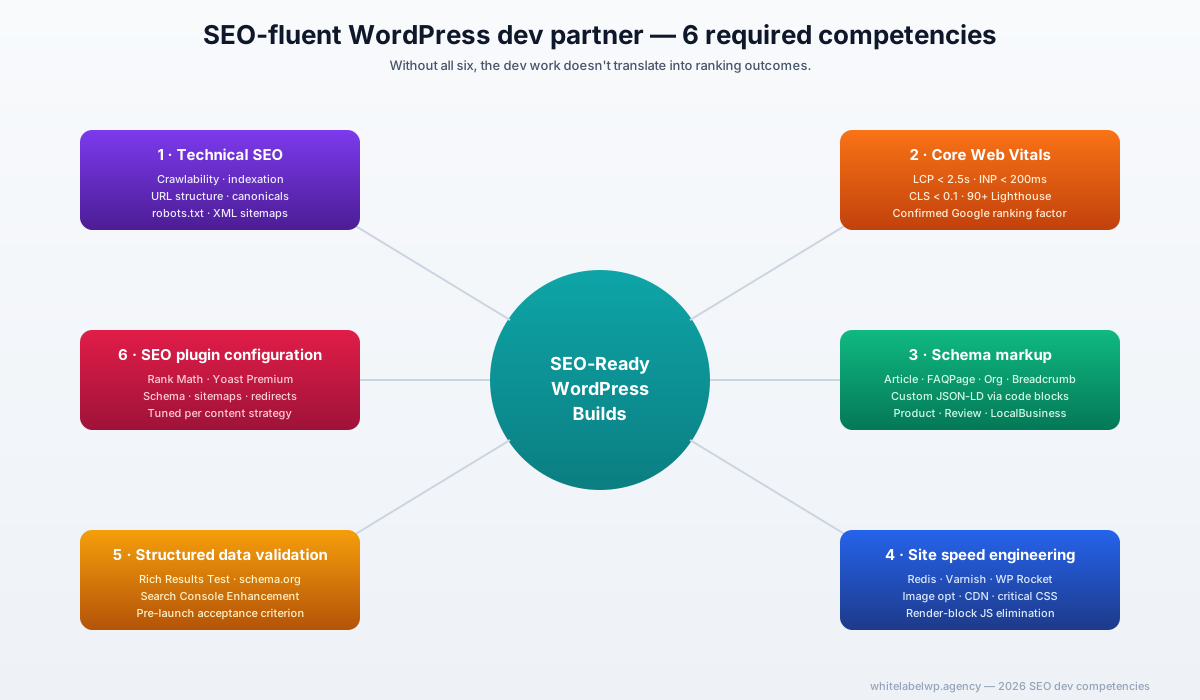
A WordPress dev partner working with SEO agencies needs fluency in six areas: technical SEO fundamentals (crawlability, indexation, URL structure), Core Web Vitals optimization (LCP, INP, CLS), schema markup implementation (Article, FAQPage, Organization, BreadcrumbList, and beyond), site speed engineering (caching, image optimization, render-blocking JavaScript elimination), structured data validation, and SEO plugin configuration depth (Rank Math or Yoast). Without all six, the dev work doesn’t translate into ranking outcomes — the agency ends up shipping sites that look fine but underperform on the metric that pays the agency’s bills.
If we’re being specific about scenarios: most agency dev partners can do 4 of the 6 well. The ones doing all 6 are the ones SEO agencies should partner with, because the gap between 4-out-of-6 and 6-out-of-6 is the difference between a site that ranks and a site that doesn’t.
Why SEO agencies need a different kind of WordPress partner
A generalist WordPress dev partner builds sites that work. An SEO-fluent partner builds sites that rank. The difference shows up in dozens of small implementation details:
- Whether the schema markup validates cleanly in Google’s Rich Results Test
- Whether Core Web Vitals scores are 90+ out of the box or only after a manual optimization sprint
- Whether the URL structure preserves existing rankings during migrations
- Whether the SEO plugin configuration is right for the client’s industry
- Whether the page speed engineering accounts for Largest Contentful Paint specifically vs generic “fast”
A non-SEO-fluent partner treats SEO as something the agency configures after launch. An SEO-fluent partner treats SEO as part of the dev work — baked into every decision from theme choice forward.
For SEO agencies committing to a multi-year client deliverable that depends on ranking outcomes, the partner choice is structural. The wrong partner caps the agency’s ranking results regardless of how well the SEO strategy is executed.
The 6 technical areas the dev partner must master
1. Technical SEO fundamentals
The foundational layer: crawlability, indexation, URL structure, redirects, canonicals, robots.txt, XML sitemaps. Things every dev partner should handle correctly but many handle inconsistently.
What an SEO agency should verify the partner does correctly:
- Clean permalink structure (
/post-name/, not/?p=123or/2026/11/post-name/) - 301 redirects properly configured (not 302s by accident, not chain redirects)
- Canonical URLs set deliberately on all paginated, taxonomy, and duplicate-risk pages
- robots.txt and XML sitemap generated correctly and submitted to Search Console
- Indexation control (noindex on staging, properly indexed on production, indexed taxonomies clean)
- hreflang configuration for multi-language sites
A partner that gets any of these wrong creates SEO debt that takes months to surface.
2. Core Web Vitals optimization
As of 2026, the metrics that affect ranking:
- Largest Contentful Paint (LCP): target under 2.5 seconds
- Interaction to Next Paint (INP): target under 200 milliseconds (replaced FID in March 2024)
- Cumulative Layout Shift (CLS): target under 0.1
A dev partner needs to architect for these from the start, not optimize for them after launch. That means:
- Preload critical resources, defer non-critical JS
- Image dimensions set explicitly to prevent CLS
- Above-the-fold content prioritized in render order
- Third-party scripts (analytics, chat widgets, fonts) audited for INP impact
The performance ceiling on the platform also matters. Bricks Builder typically scores 10-15 Lighthouse Performance points higher than Elementor on equivalent designs — for SEO-driven sites, that gap compounds into ranking outcomes.
3. Schema markup implementation
Schema is where AEO (Answer Engine Optimization) and traditional SEO converge in 2026. The schemas every SEO-driven WordPress site should have:
- Article schema on every blog post and editorial page
- FAQPage schema on any page with Q&A content
- Organization schema sitewide (company info, social profiles, logo)
- BreadcrumbList on every page
- WebSite with sitelinks search box configured
Schemas to add when the content fits:
- Product schema on e-commerce pages
- Review and AggregateRating on review pages
- LocalBusiness on service-area sites
- HowTo on tutorial content
- Event on event listings
A partner that handles schema via plugin defaults misses opportunities. A partner that can implement custom JSON-LD directly via Bricks custom code blocks, Elementor’s HTML widget, or theme-level injection in functions.php captures schemas Rank Math doesn’t auto-generate.
4. Site speed engineering
Speed is part of every Core Web Vital but deserves its own competency. The full toolkit:
- Server-level caching via Redis, Varnish, or hosting-native cache (WP Engine, Kinsta)
- Application caching via WP Rocket, FlyingPress, or LiteSpeed Cache
- Image optimization via ShortPixel, Smush, or build-step WebP conversion
- Database optimization (WP-Optimize for table cleanup, transient management)
- Critical CSS generation and inline injection
- Render-blocking resource elimination
- CDN configuration (Cloudflare, Bunny CDN, or hosting-included)
A site delivered at 80 Lighthouse Performance vs 95 is a meaningful difference on rankings over 90-180 days for competitive keywords. The dev partner’s process needs to default to 90+ delivery, not “we can optimize that later for an additional fee.”
5. Structured data validation
Every schema implementation needs validation before launch:
- Google’s Rich Results Test for visibility of each schema type
- Schema.org validator for technical compliance
- Search Console Enhancement reports for ongoing monitoring post-launch
The dev partner’s process should include “schema validates without errors” as an acceptance criterion on every build, not a post-launch QA discovery. Catching schema issues before launch is roughly an order of magnitude cheaper than catching them three months in when Search Console flags them.
6. SEO plugin configuration (Rank Math / Yoast)
Both Rank Math and Yoast can produce excellent SEO outcomes. The differentiator is configuration depth.
For Rank Math specifically:
- Schema module configured per content type
- Sitemap settings tuned (include/exclude taxonomies appropriately)
- Redirection module managing 301s (the agency’s source of truth for URL changes)
- Analytics module integrated with Search Console
- Local SEO module configured for service-area clients
For Yoast Premium specifically:
- XML sitemap segmented by content type
- Internal linking suggestions enabled
- Cornerstone content marked for hierarchy
- Schema customization for non-standard content
A partner that ships the default configuration and walks away misses the optimization layer. A partner that configures the plugin against the client’s specific content strategy delivers SEO infrastructure the agency can actually build on.
What SEO agencies should brief the partner about specifically
A standard build brief covers content, design, and technical requirements. An SEO-driven brief adds:
- Existing organic traffic profile (top 20 URLs, focus keywords, ranking positions)
- Target keyword map for the new site
- Schema requirements beyond defaults (Product, Review, LocalBusiness, etc.)
- Performance budget (target Lighthouse, target LCP, target CLS)
- URL preservation requirements if it’s a migration
- Internal linking strategy if there’s a deliberate pillar-cluster architecture
- GSC and analytics handoff requirements
For more on briefing structure, see our briefing framework.
How to test a partner’s SEO-relevant skills before signing
Three concrete tests:
Test 1 — Run their site through Lighthouse. A partner that can’t deliver 90+ Lighthouse Performance on their own marketing site usually can’t deliver it on client work either. Quick filter.
Test 2 — Ask for schema implementation samples. Request a previous client site’s URL where they’ve implemented FAQPage or Product schema. Run the URL through Rich Results Test. If errors surface or schemas are missing on pages that should have them, it’s a fit problem.
Test 3 — Talk through a migration scenario. Pose a hypothetical: “client on Wix with 30 ranking pages, what’s your migration approach?” A SEO-fluent partner answers with URL audit, 301 mapping, content parity, DNS cutover, post-launch monitoring. A non-SEO-fluent partner answers with “we’ll move the content over.”
Common gaps in WordPress dev partners that hurt SEO agencies
Three recurring gaps we see:
- Schema treated as plugin defaults only. No custom JSON-LD work, no schema strategy beyond what Rank Math auto-generates.
- Performance treated as optional. Sites ship at 70-80 Lighthouse, optimization is a paid add-on rather than a default.
- Migration handled without URL audit. 301 redirects are an afterthought; ranking loss is “acceptable” and “recovers over time.”
Any of these in a partner’s process makes them a poor fit for SEO agency work specifically. They might be fine for non-SEO-driven clients; for SEO agencies, the gap is commercial.
The care plan side — ongoing SEO maintenance
A WordPress site post-launch needs ongoing SEO care:
- Quarterly Search Console review (new errors, indexation drift)
- Monthly Core Web Vitals monitoring (regression detection)
- Quarterly schema audit (changes in Google’s structured data requirements)
- Plugin compatibility checks (some updates break schema or performance)
- Migration of URL changes through the Rank Math Redirection module
This is care plan territory. For pricing on SEO-aware care plans, see our care plan pricing benchmark. SEO-focused care typically sits in the Standard or Premium tier ($179-$399/month) because of the quarterly review depth.
Where White Label WP Agency fits
We run SEO-focused WordPress workflows as a default for SEO agency partners. Every build includes performance baseline, schema implementation, Rank Math configuration, and URL handling as standard scope — not as paid upgrades. Every migration follows the SEO-preserving playbook. Every care plan includes Core Web Vitals monitoring.
For SEO agencies evaluating WordPress dev partners, our builds service and migrations service document the SEO discipline we apply. Care plans include the ongoing maintenance side. Book a partner call to walk through your specific client SEO requirements.
Frequently asked questions
What should an SEO agency look for in a WordPress development partner?
Six technical competencies: technical SEO (crawlability, indexation, URL handling), Core Web Vitals optimization, schema markup implementation, site speed engineering, structured data validation, and SEO plugin configuration depth. A partner without all six produces sites that look fine but underperform on rankings. Ask about their process for performance auditing, schema setup, and how they handle migrations without losing organic traffic — the answers reveal depth.
Why does Core Web Vitals matter for an SEO agency’s WordPress builds?
Core Web Vitals (LCP, INP, CLS) are a confirmed Google ranking factor as of 2026. For SEO-driven client sites, the difference between a 75 and 92 Lighthouse Performance score often translates to measurable ranking and traffic differences over 90-180 days. An SEO agency that ships sites with poor performance is undermining its own service deliverable; the dev partner needs to deliver performance-optimized sites by default, not as a separate upgrade.
Should the WordPress dev partner handle schema markup, or should the SEO agency configure it?
Both work, but partner-handled is usually cleaner. Rank Math and Yoast handle most standard schema automatically, but custom schema (Product, Review, LocalBusiness with detailed attributes, FAQPage, HowTo) often requires dev intervention. A dev partner that can implement custom JSON-LD via Bricks/Elementor custom code blocks or theme-level injection saves the SEO agency hours of plugin wrestling per project.
What WordPress page builder is best for SEO-driven client work?
Bricks Builder typically wins for SEO-focused work because of cleaner front-end markup and better Core Web Vitals scores out of the box. Elementor and Divi can produce SEO-grade sites with optimization work, but the structural performance advantage of Bricks compounds across a client portfolio. For SEO agencies that haven’t standardized a page builder, Bricks is the structurally better default in 2026.
Can a white-label partner deliver SEO-quality WordPress work consistently?
Yes, if their process bakes in the six technical areas. White Label WP Agency runs SEO-focused workflows for agency partners across builds, care plans, and migrations. Every build includes performance baseline, schema implementation, and Rank Math/Yoast configuration as standard scope — not as upgrades. The 200+ SEO agency partnerships we’ve worked with consistently report ranking outcomes equivalent to or better than in-house dev work.
How does WordPress migration affect an SEO agency’s existing rankings?
Significantly if the migration isn’t handled correctly. The four ways migrations lose rankings — missing 301 redirects, URL structure mismatch, on-page content drift, slow DNS cutover — apply directly to SEO agency work. A dev partner unfamiliar with SEO-preserving migration playbook can wipe out 6-12 months of SEO investment in a single botched cutover.