White Label WordPress Partner for US Marketing Agencies
What US marketing agencies should look for in a white-label WordPress partner. Time zone overlap, NDA structure, cost math, and when on-shore is better.
White Label WordPress Partner for US Marketing Agencies
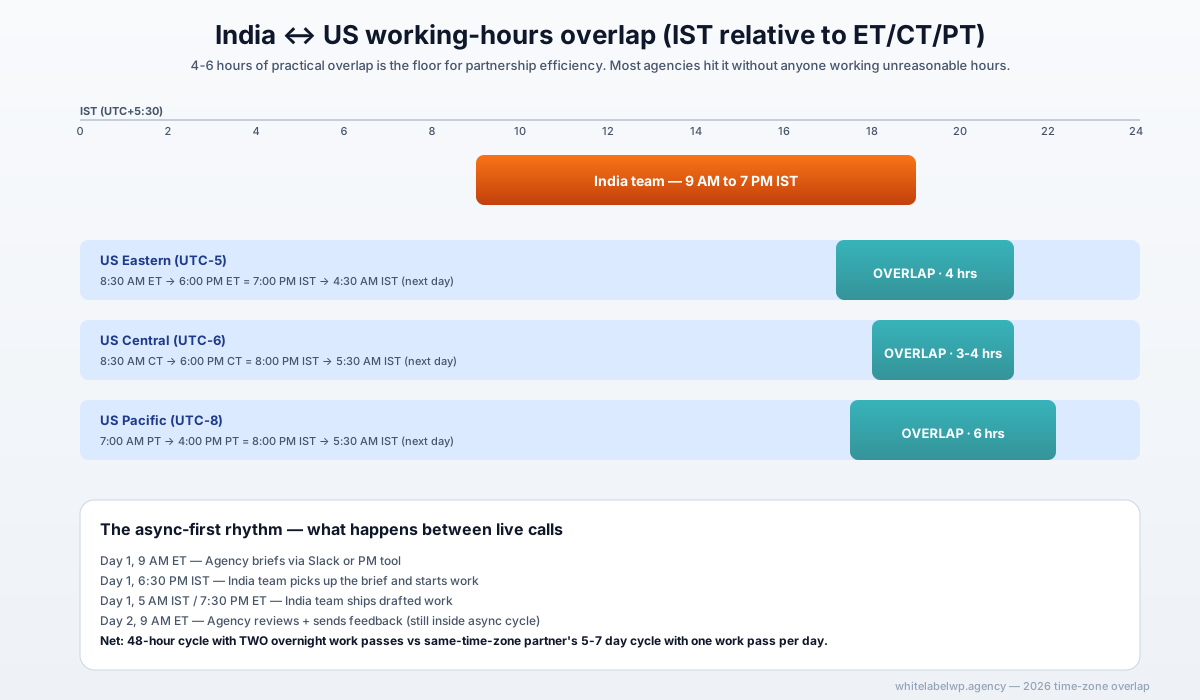
For US-based marketing agencies in 2026, a white-label WordPress partner needs to clear five fit tests: time-zone overlap with US business hours (4-6 hours of practical overlap is the floor), NDA structure that holds up in US courts, code ownership transfer at delivery, communication style that matches the agency’s PM cadence (Slack/email async-first usually wins), and a delivery quality bar that holds up to US client expectations. India-based partners can clear all five. The typical White Label WP Agency partnership has 4 hours of working-hours overlap with US Eastern, 6 with US Pacific, and operates as if the team were embedded.
The honest read: the offshore-vs-on-shore decision isn’t about time zones. It’s about whether the operational model can produce US-client-quality work consistently. The time-zone math is solvable; the quality bar is the real question.
The 5 fit tests for a US agency choosing a white-label WordPress partner
1. Time-zone overlap with US business hours
The practical floor is 4 hours of working-hours overlap with the agency’s primary working window. Below that, async coordination becomes friction and live calls become inconvenient. Above 4 hours, the working rhythm becomes routine within 30 days.
From India (Indian Standard Time, UTC+5:30):
- US Eastern (UTC-5): 4-hour overlap window from approximately 7:00 PM IST to 11:00 PM IST = 8:30 AM to 12:30 PM Eastern.
- US Central (UTC-6): 4-hour overlap, shifts one hour earlier in US time.
- US Pacific (UTC-8): 6-hour overlap from 6:00 AM to 12:00 PM Pacific = 7:30 PM to 1:30 AM IST.
For most US agencies this is enough overlap to handle daily standup, urgent client questions, and weekly review calls without anyone working unreasonable hours. The async-first work happens overnight from the agency’s perspective — brief in the morning, finished work waiting in the morning two days later.
2. NDA structure that holds up in US courts
The five sections any white-label NDA needs — mutual confidentiality, non-solicit, IP transfer, term/survival, jurisdiction — all need to be present. For US agencies engaging India-based partners, the critical clause is jurisdiction. Specify US governing law and a defined dispute resolution venue (typically arbitration in a named US city or court jurisdiction). This makes the NDA enforceable in US courts if needed.
For the full NDA structure, see our white label NDA framework. The clause that matters for cross-border partnerships is the governing law and venue specification — it determines where disputes are resolved if a non-solicit violation or IP transfer issue ever surfaces.
3. Code ownership and IP transfer
Every line of code, every design file, every custom plugin produced under the engagement should be the agency’s property the moment of delivery. The NDA’s IP transfer clause handles this contractually; the operational discipline of clean delivery handovers handles it practically.
What to verify in the partnership:
- Written IP transfer in the NDA or master services agreement
- GitHub or equivalent repo access at engagement kickoff
- Credentials for all client systems handed back at delivery
- No partner-installed monitoring or analytics that the agency doesn’t control
This protects the agency’s ability to switch partners, sell client books, or modify deliverables later without ambiguity.
4. Communication style and cadence
The partnership’s communication style needs to match the agency’s PM workflow. For most US agencies, that’s:
- Async-first via Slack or email — primary channel for daily work
- Weekly live call (45-60 minutes) in the working-hours overlap window for strategic items and project review
- Project management tool integration (ClickUp, Asana, Linear, Notion — whatever the agency uses internally)
- Defined response time SLAs (24 hours business is standard; 4 hours for priority items)
The most common friction point we see in offshore partnerships isn’t time zones — it’s mismatched communication expectations. Agencies that expect synchronous Slack response struggle with async-first partners; agencies set up for async work fine. Aligning expectations in the first week prevents 90% of communication friction.
5. Delivery quality bar
The work needs to ship at a quality level US end clients accept. This is the real differentiator across white-label partners — not the geography, not the cost, not the time zone.
What to test in the first 90 days (the 90-day partner test framework covers this in detail):
- First-time acceptance rate above 70% on agreed acceptance criteria
- Code quality assessable on the agency’s own standards (linting, performance, accessibility)
- Visual quality that holds up against the agency’s design standards
- Communication consistency under deadline pressure
Geography is a non-factor on quality. The partner’s internal process and team is what matters.
India-based partners — the time-zone math actually works
The instinct most US agency owners have is that a 9-11 hour time difference creates friction. In practice, it creates an overnight delivery cycle that often produces faster turnaround than working with same-time-zone partners.
Standard rhythm with a US Eastern agency:
- Day 1, 9 AM Eastern: Agency briefs work via Slack or PM tool
- Day 1, 6:30 PM India: Partner team picks up the brief and starts work
- Day 1, midnight India / 2:30 PM Eastern: Partner sends mid-progress check or questions
- Day 1, 5 AM India / 7:30 PM Eastern: Partner ships drafted work
- Day 2, 9 AM Eastern: Agency reviews and approves or sends feedback
- Day 2, 6:30 PM India: Partner iterates
- Day 3, 9 AM Eastern: Agency receives finished work
That’s a 48-hour cycle on a standard work item with two full overnight work passes. Same-time-zone partners typically deliver in 5-7 days on the same scope because they have only one work pass per day.
The math: the time-zone difference is an asset for async-tolerant work, not a liability. The work-types that don’t benefit are anything requiring synchronous design review or real-time client calls. Most agency WordPress work — builds, care, plugin development, migrations — is async-tolerant.
What US agencies should ask before signing
Before committing to a white-label partner, get clear answers to:
- What hours does your team work? What’s the practical overlap with our agency’s working window?
- Who’s our dedicated PM and how long have they been with the company?
- What’s the standard SLA for response time on Slack/email?
- Can you sign a mutual NDA under US law with arbitration in a US venue?
- Do you transfer code ownership at delivery? Confirm in writing.
- Can we start with a single trial project before committing to a retainer?
- What happens if our agency wants to exit the relationship — notice period, code handover, etc.?
- Can you provide references from US agencies you’ve worked with for 12+ months?
A partner that struggles to answer any of these isn’t ready for a serious US agency engagement. References are particularly valuable — the partnerships that have been running 1+ year are the ones whose process actually works.
When an on-shore US partner is the better call
Honest scenarios where US-based wins:
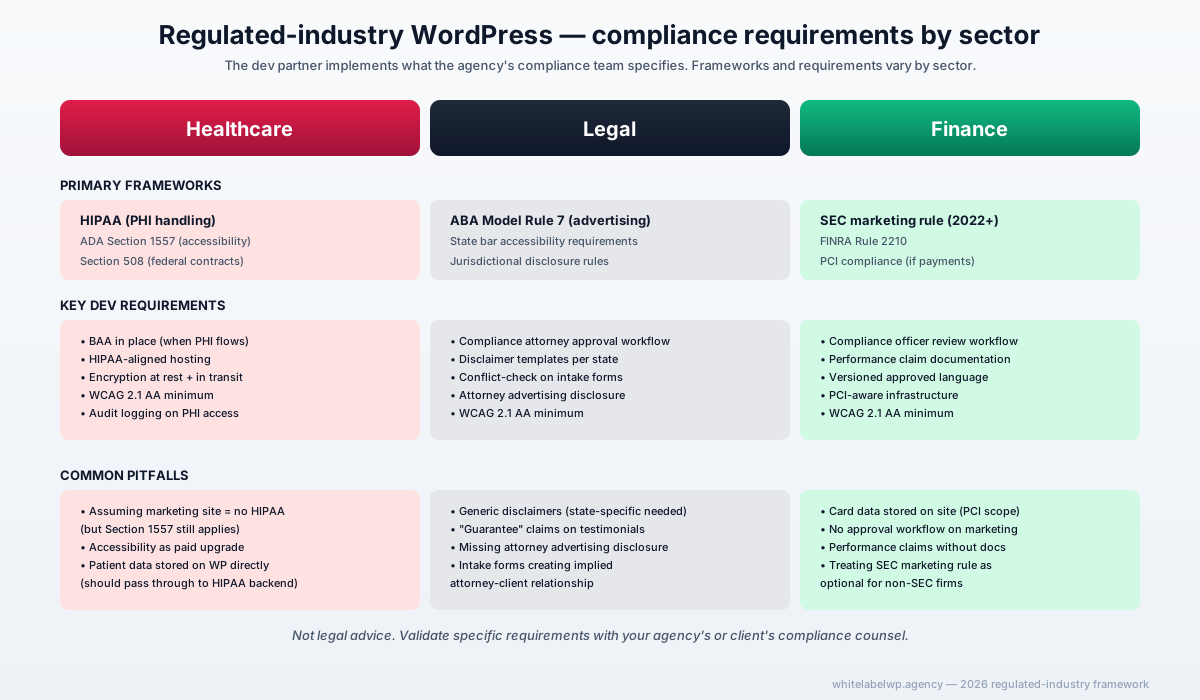
- Regulated-industry clients with US data residency requirements. Healthcare, finance, government — clients sometimes require all development and data handling to occur within US borders.
- Real-time pair programming or design reviews. If your agency’s process depends on synchronous collaboration in working hours, on-shore is easier.
- Time-zone tolerance below 4 hours. Some agency cultures struggle with async work; for those, the same-time-zone option reduces operational friction even at higher cost.
- In-person meeting expectations. If your client base expects occasional on-site visits, an India-based partner can’t provide that. (Most US agencies don’t run their work this way anymore, but some still do.)
If any of those describe your agency, the cost premium of US-based partners is worth absorbing. Look at WebDevStudios, 10up, or similar US-based shops in those cases.
The cost comparison — US-based vs offshore vs nearshore
Typical 2026 effective hourly rates for white-label WordPress delivery:
| Partner type | Effective rate | Typical retainer cost (55-60 hrs) |
|---|---|---|
| India-based offshore | $18-$25 | $1,099-$1,500 |
| Eastern Europe nearshore | $30-$45 | $1,800-$2,700 |
| Latin America nearshore | $35-$55 | $2,100-$3,300 |
| US-based onshore | $50-$80 | $3,000-$4,800 |
The cost differential between India-based and US-based is meaningful — roughly 50-65% less for the same hour band. For an agency running 600-700 dev hours/year of WordPress work, the savings compound to $25,000-$40,000+ per year.
Cost shouldn’t be the deciding factor but it’s a real variable. For most US agencies with async-tolerant workflows, the offshore option produces equivalent quality at significantly lower cost.
Where White Label WP Agency fits for US agencies
We serve US-based agencies as our largest geographic segment. Standard practice for US agency partnerships:
- Mutual NDA under US law with arbitration in a US venue
- 4-hour overlap window with US Eastern (7-11 PM IST = 8:30 AM – 12:30 PM Eastern)
- Weekly live call in the overlap window; async work via Slack/email outside of it
- US-based references available for new partnership conversations
- Standard PMs assigned to US agencies have 3+ years of US client experience
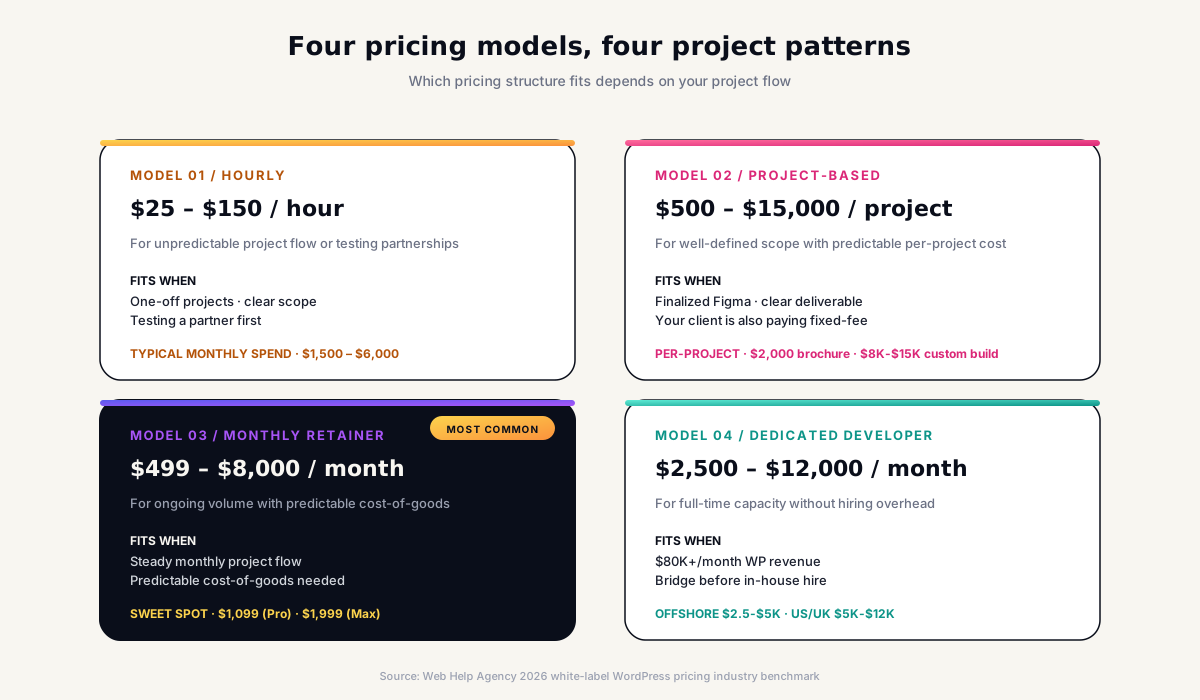
Our builds service and care plans cover the work surface. Pro retainers at $1,099/month and Max at $1,999/month are the typical commit levels for US agency partnerships. Book a partner call to walk through your specific pipeline and time-zone needs.
Frequently asked questions
Can a US marketing agency work with an India-based white-label WordPress partner?
Yes — most India-based partners that serve US agencies maintain working-hours overlap with US time zones. A typical engagement has 4-6 hours of overlap with US Eastern, 6-8 hours with US Pacific. Day-to-day work happens async over Slack or email; live calls are scheduled in the overlap window. The 800+ US agency partnerships we’ve watched run on this model report no material time-zone friction once the working rhythm is established.
How does NDA enforcement work between US agencies and India-based partners?
Mutual NDAs structured under US law with a defined dispute resolution clause (typically arbitration in a named venue or US court jurisdiction) hold up cleanly. The NDA needs the same five sections any white-label NDA needs — mutual confidentiality, non-solicit of end clients, IP transfer, term/survival, jurisdiction — with the jurisdiction clause specifying US governing law for enforcement reach. White Label WP Agency signs mutual NDAs under US law for US-based agency partners as standard practice.
What does an India-based partner cost compared to a US-based white-label partner?
India-based partners typically run 40-60% less per dev hour than US-based equivalent. A White Label WP Agency Pro retainer at $1,099/month for 55-60 dev hours works out to $18-$20/effective hour vs $50-$80/effective hour for US-based partners. The cost difference is meaningful at scale — across 50+ client sites per year, the savings compound to $50K-$150K annually in delivery cost.
How does communication work async across a 9-11 hour time difference?
Cleanly, with the right rhythm. Standard practice: agency briefs in their morning (partner’s evening), partner ships work overnight (agency morning), agency reviews and responds in their afternoon (partner’s morning). Weekly live calls in the 4-6 hour overlap window for strategic items. Daily Slack or email for tactical questions. After the first 30 days, the rhythm becomes invisible. Most US agency partners we work with report the async model is actually faster than working with on-shore partners on the same time zone — work happens overnight instead of waiting for the next business day.
What’s the biggest mistake US marketing agencies make choosing an offshore partner?
Treating cost as the primary decision driver. Cost matters but it’s the third or fourth factor behind delivery quality, communication consistency, and NDA structure. Agencies that pick the cheapest partner often end up paying more in management overhead, rework, and client churn than they would have on a slightly more expensive partner with better processes. The right framing: “what’s the all-in cost including my team’s time?” — not just the per-hour rate.
Does a white-label partner work for full-service marketing agencies or only WordPress-focused ones?
Both. Full-service marketing agencies (SEO + content + paid + WordPress) outsource the WordPress delivery while keeping the strategy, account management, and other service lines internal. WordPress-focused agencies use a partner to absorb steady delivery volume. The partnership scope is the same in both cases — the difference is what the agency does in-house alongside it. White Label WP Agency serves both models.