Building a $50K MRR WordPress Care Plan Book
The four-lever playbook for scaling a WordPress care plan book to $50K MRR. 24-36 month roadmap, real margin math, and what changes at the milestone.
Building a $50K MRR WordPress Care Plan Book
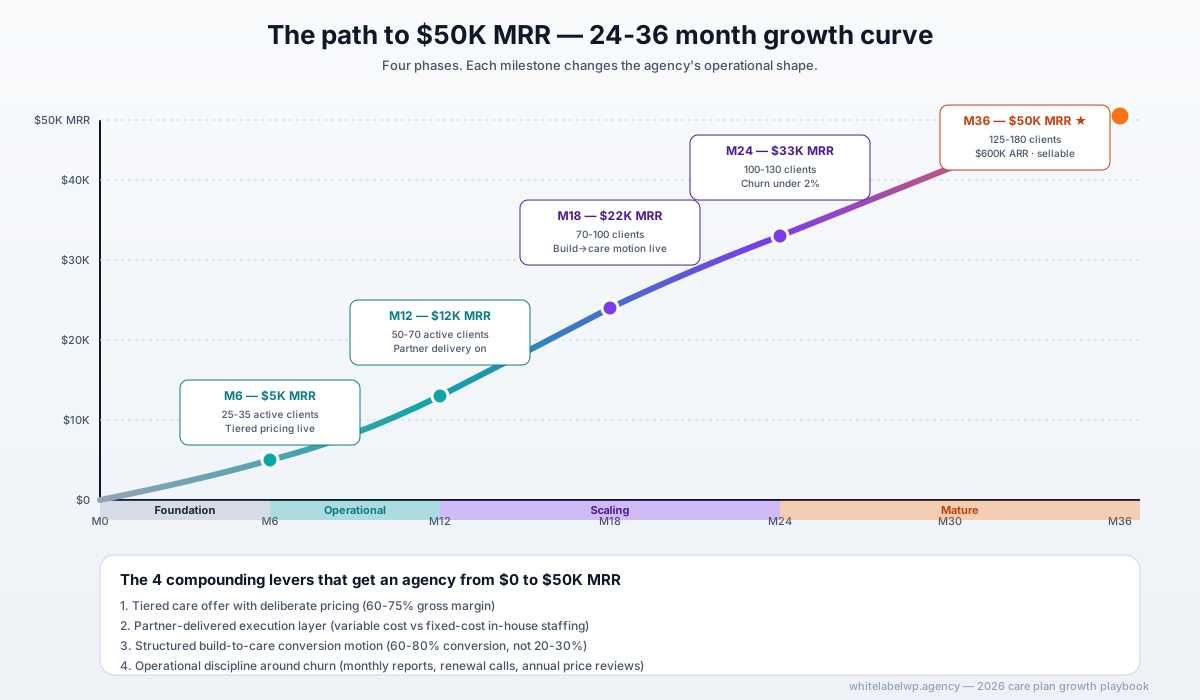
A $50K MRR WordPress care plan book is a real and achievable agency milestone — but it’s not a goal you reach by adding clients faster. It’s a system built on four compounding levers: a tiered care offer with deliberate pricing (60-75% gross margin), a partner-delivered execution layer that scales without hiring, a defined sales motion to convert new build clients into care clients (60-80% conversion), and operational discipline that handles churn before it becomes a leak. The 200+ agencies we’ve watched cross $50K MRR in care all had these four levers in place by month 18; most needed 24-36 months to get there.
The honest read: agencies that try to brute-force their way to $50K MRR by adding clients without the four levers usually plateau at $15-$25K MRR and burn out. The system is what makes the climb sustainable.
What $50K MRR care actually looks like (the agency at the milestone)
Before mapping the path, name the destination. An agency operating a $50K MRR care plan book in 2026 typically looks like:
- 125-180 active care clients across the four pricing tiers (Basic, Standard, Premium, Enterprise)
- $300-$400 average revenue per care client per month
- 60-75% gross margin on the care book ($30K-$37.5K monthly gross profit)
- 1-2% monthly churn — losing 1-3 clients per month, replacing them in the new-client pipeline
- Partner-delivered or hybrid execution — most agencies at this scale use a white-label partner for delivery, with 1-2 internal staff coordinating
- $600K annual recurring revenue from care alone — typically representing 30-60% of total agency revenue, with builds and one-off project work making up the rest
- Acquisition value of $1.2M-$2.4M at 2-4x ARR multiples for the care book alone
That’s a real agency business. Not a side hustle, not an inconsistent revenue stream — a durable, sellable recurring revenue line.
The 4 compounding levers
1. Tiered care offer with deliberate pricing
Agencies that plateau under $25K MRR almost always have one of two pricing problems: custom-quoted care (no published tiers) or underpriced care across the board (mostly $99-$149 plans).
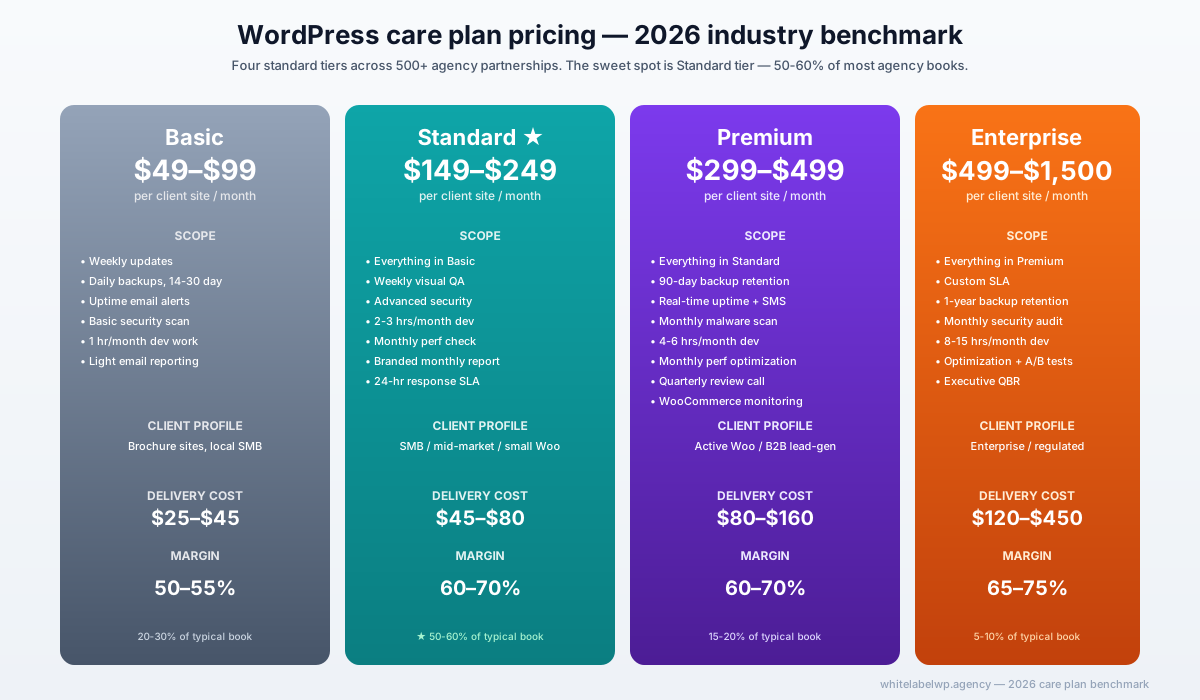
The agencies that reach $50K MRR have a published four-tier offer:
- Basic at $49-$99/month
- Standard at $149-$249/month
- Premium at $299-$499/month
- Enterprise at $499-$1,500/month
The tier structure does three things: makes pricing comparable for clients, allows tier-based scope creep without renegotiation, and creates an upgrade path that compounds revenue without adding clients.
Most $50K MRR agencies see 50-60% of clients on Standard, 15-25% on Premium, and a long tail across Basic and Enterprise. The mix shifts toward higher tiers over time as the agency learns to position scope at higher price points.
For the full pricing benchmark and tier scope, see our WordPress care plan pricing breakdown.
2. Partner-delivered execution layer
A 150-client care book delivered in-house requires roughly 3-5 full-time maintenance staff. At fully-loaded cost of $60-$90K per FTE, that’s $200-$400K/year in delivery cost. The math doesn’t break the agency, but it absorbs 30-50% of care revenue in fixed people cost and concentrates risk in a small operational team.
Partner-delivered care changes the unit economics. A white-label partner running Standard-tier care at $45-$70/month per client delivers the same 150-client book for $7-$11K/month — that’s $84K-$132K/year, against $200-$400K in-house. The agency captures the difference as gross margin.
The other compounding effect: partner-delivered execution is variable cost. New client added? Partner cost scales linearly. Client churns? Cost drops immediately. In-house delivery is fixed cost — you pay the FTE whether or not the book is growing.
Most $50K MRR agencies discovered this lever between month 12 and 24. The agencies that figured it out earlier reached $50K faster; the agencies that hired in-house too early often stalled around $20-$30K MRR because the next hire would have destroyed margin and the existing team was already overcommitted.
3. Build-to-care conversion motion
The single biggest source of new care clients for an established agency is graduating new build clients into ongoing care. The agencies that win at this don’t sell care as a separate conversation — they bake it into the build process.
The structural motion:
- Every build proposal includes a “30-day post-launch care plan” at zero additional charge.
- The launch checklist includes a Day 25 conversation framed as “what’s next” — covering content cadence, performance monitoring, security posture, and ongoing maintenance.
- The conversation presents a care plan as the natural next step, with tier recommendation tied to the client’s actual site complexity.
- Acceptance triggers a clean handoff to the ongoing care delivery team (internal or partner).
Agencies running this motion convert 60-80% of new build clients into ongoing care. Agencies that wait until after launch to start the care conversation convert 20-30%. The 3x difference compounds across years.
The math: 20 builds per year × 70% conversion = 14 new care clients per year. Over 24 months at this rate, the agency adds 28 care clients from build conversion alone — typically about half the clients needed to hit $50K MRR from scratch.
4. Operational discipline around churn
Care plan churn is the silent killer. A book growing by 5 net new clients per month while losing 4 per month feels like growth — but the math says it’s barely treading water. The agencies that reach $50K MRR don’t necessarily acquire faster; they churn slower.
Three operational disciplines move the churn needle:
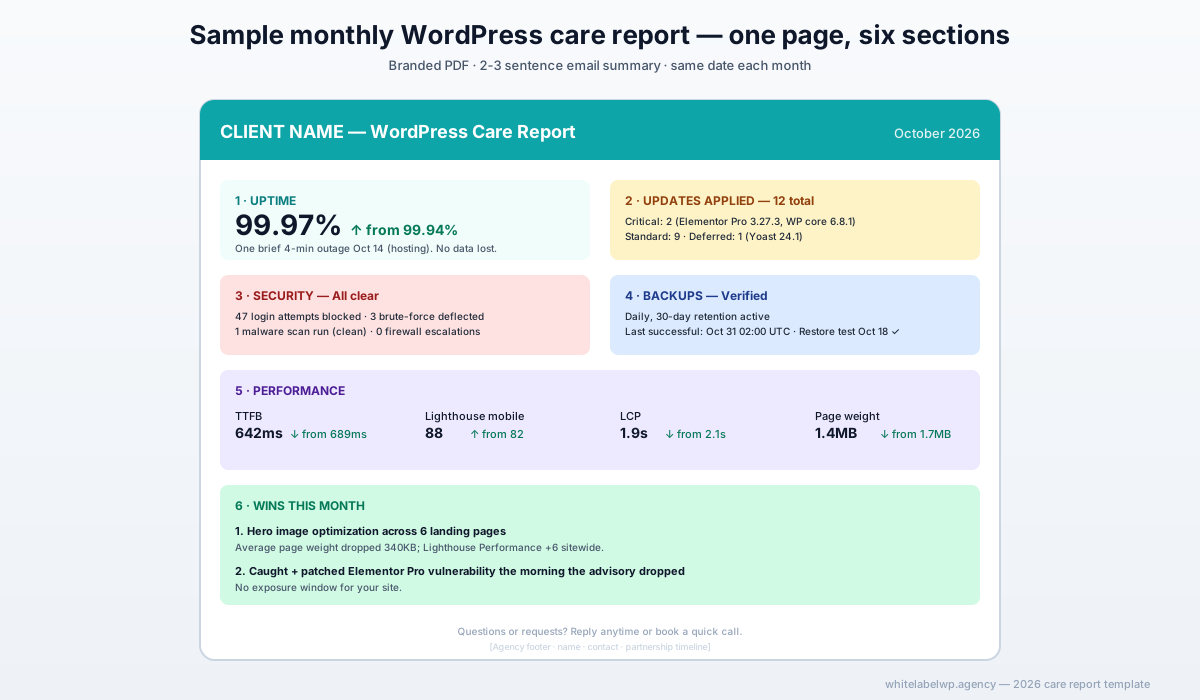
Monthly reporting clients can see value in. A branded monthly care report — uptime stats, updates applied, security events handled, performance trends, content changes shipped — keeps the client aware of the value being delivered. Care plans churn most often when the client forgets why they’re paying. Visible value prevents the question. See our care plan pricing breakdown for what each tier’s report should cover.
Proactive renewal conversations. Schedule a 30-minute renewal call 60 days before the contract anniversary. Walk through the prior 12 months, the next-year roadmap, and any tier adjustment. Most renewals close on this call before they ever become a “should we keep paying?” question.
Honest pricing tier recommendations. Clients who feel they’re overpaying churn. Clients who feel they’re underpaying for the value churn the moment a cheaper option appears. Annual tier reviews catch both ends — agencies that recommend downgrades when scope warrants it earn long-term trust that prevents one-shot churn decisions.
Hit 1-2% monthly churn and the care book grows almost on autopilot once the acquisition motion is steady. Hit 5%+ churn and the book runs in place no matter how fast new clients arrive.
The growth math — from $5K MRR to $50K MRR
Indicative milestones along the path:
| Stage | Active care clients | Avg ticket | MRR | Time from start |
|---|---|---|---|---|
| Foundation | 25-35 | $150-$180 | $4K-$6K | Months 1-6 |
| Operational | 50-70 | $180-$220 | $10K-$15K | Months 7-12 |
| Scaling | 80-110 | $220-$280 | $20K-$30K | Months 13-24 |
| Mature | 125-180 | $280-$350 | $40K-$55K | Months 25-36 |
The Operational → Scaling transition is where most agencies stall. The Foundation phase is straightforward: convert your existing book into tier-priced clients. The Scaling phase requires the four levers to be running together — pricing discipline, partner execution, build-to-care motion, churn management. Agencies missing any single lever rarely cross $25K MRR.
The 24-36 month roadmap
Months 1-6 — Foundation
Goals: convert existing book to tiered pricing, establish operational baseline.
- Audit existing maintenance clients. Map current scope to four tiers.
- Publish tier prices. Notify existing clients of tier alignment.
- Set up monthly reporting cadence with branded reports.
- Choose your execution path: internal team, white-label partner, or hybrid.
- Document the standard delivery process so it’s repeatable.
End state at month 6: $4K-$6K MRR, 25-35 active care clients, repeatable monthly delivery.
Months 7-18 — Scale operations
Goals: build-to-care conversion motion live, partner delivery operational, churn discipline in place.
- Restructure build proposals to include 30-day post-launch care
- Set up the Day 25 “what’s next” conversation as standard practice
- Onboard with a white-label care delivery partner (if not already done)
- Schedule first annual price reviews with existing clients
- Roll out the 60-days-before renewal call cadence
- Begin tracking churn rate monthly; surface anomalies fast
End state at month 18: $15K-$25K MRR, 70-100 active clients, 60-80% build-to-care conversion measured, churn under 3% monthly.
Months 19-36 — Compound
Goals: lift average ticket through tier upgrades, expand to Premium and Enterprise tier clients, drive churn below 2%.
- Annual tier reviews catching scope creep and moving clients up
- Launch Premium tier proactively for sites that have outgrown Standard
- Begin selling Enterprise tier to existing mid-market clients with growing complexity
- Refine the renewal motion based on accumulated data
- Consider hiring an internal care coordinator (not delivery staff) at 120+ clients
- Build a 12-month forward financial model now that the business is real
End state at month 36: $40K-$55K MRR, 125-180 active clients, average ticket above $300, churn at 1-2% monthly.
The five mistakes that stall agencies at $15-$25K MRR
Three years of running care delivery for agencies reveals consistent stall patterns:
-
Custom-quoting every care plan. Care becomes a sales project, not a productized service. Sales cycle stretches; close rate drops; the agency doesn’t get to volume.
-
Underpricing the Basic tier and over-delivering scope. “Basic” becomes a Standard-scope plan at a Basic price. Margin compression makes the book unprofitable to scale.
-
Trying to grow on builds alone, not building the conversion motion. New builds happen but the structured handover to care doesn’t. 20-30% conversion rate, not 60-80%, means twice as many builds needed to grow the same MRR.
-
Hiring in-house delivery too early. $25K MRR book doesn’t justify 2-3 FTE maintenance staff. The fixed cost destroys margin and lock-step pressure to grow accelerates faster than the operational maturity supports.
-
No renewal cadence, no monthly reporting. Clients forget why they’re paying. Churn rate creeps to 4-6% monthly. The book runs in place.
Avoiding all five is what differentiates the $50K MRR cohort from the agencies stuck at $15-$25K.
How partner delivery enables the climb
This is the most underrated lever. The conventional agency model is to scale care by scaling people — hire two, then three, then four maintenance specialists. Every hire is a 90-day onboarding cycle, a fixed cost commitment, and a single point of failure when someone leaves.
Partner delivery flips the model. The agency outsources execution to a specialist team that already has standardized processes, redundant staffing, and economies of scale across hundreds of agency partners. The agency keeps the client relationship, the pricing power, and the gross margin; the partner handles the work.
Concrete numbers for a 150-client care book:
- Internal delivery cost: $200K-$400K/year (3-5 FTE maintenance specialists)
- Partner-delivered cost: $84K-$132K/year (at $45-$70/client/month)
- Margin difference captured by agency: $116K-$268K/year
That margin difference is what funds growth investment (sales hires, marketing spend, business development) without compressing care unit economics. The agencies that figure this out compound; the ones that don’t plateau.
For agencies evaluating partner delivery options, our 90-day partner test covers the structured evaluation framework. The scaling without hiring pillar covers the broader operational case.
What changes about the agency at $50K MRR care
The agency at $50K MRR care doesn’t look like the same agency at $5K care — even when the team structure is similar. Six things that shift:
-
Cash flow predictability. $50K coming in on the 1st of every month changes how the agency makes decisions. Project pipeline doesn’t have to be solved every month; the floor is set.
-
Strategic agility. With predictable revenue, the founder can take longer-term bets — new service lines, hiring, marketing investment — without immediate ROI pressure.
-
Sales-team specialization. Care plan sales becomes a different motion than build sales. Many $50K-MRR agencies separate the two — a build-focused sales lead and a care-focused account manager.
-
Operational hires shift from delivery to coordination. The hires that matter are care coordinators, account managers, and customer success — not maintenance specialists, because partner delivery handles the work.
-
Acquisition becomes plausible. $600K ARR books sell at 2-4x. The agency that didn’t have an exit story before now has one.
-
The founder’s time changes. Less in delivery, more in strategy, sales, and partnership oversight. The role looks more like a CEO than a senior practitioner.
Beyond $50K — the $100K MRR question
For agencies that reach $50K MRR, the next milestone of $100K MRR raises a structural question: can the same model scale, or does it need to evolve?
The honest answer: the same four levers continue to work, but the operational layer typically needs to evolve. Agencies past $50K MRR usually:
- Hire a dedicated VP of Customer Success or Head of Care
- Implement formal NPS or CSAT measurement
- Split client books by industry or tier across team members
- Move from a single partner-delivery relationship to multi-partner redundancy (or in-house augmentation)
- Begin building proprietary care tooling that becomes a moat
The $100K MRR threshold takes another 18-30 months from $50K for most agencies. It’s the same playbook executed at higher scale, with more operational sophistication.
Where White Label WP Agency fits
We deliver care plans for agency partners across all four tiers under the agency’s brand and NDA. The unit economics of partner-delivered care are what make the climb from $5K MRR to $50K MRR feasible without absorbing fixed cost.
For agencies actively building toward $50K MRR, the partnership typically deepens over time: early stage uses our care delivery as one component of the build-to-care motion; later stage uses our Max retainer to absorb 80-150 clients of delivery cost inside a flat monthly fee.
Our care service documents the four-tier scope. Pro and Max retainers are the economic structure that supports the climb to $50K MRR. Book a partner call to walk through your current care book and map the 24-36 month path forward.
Frequently asked questions
How long does it take to build a $50K MRR WordPress care plan book?
For an agency starting from $0 in care MRR, 24-36 months is the realistic path. Agencies with existing 10-20 active maintenance clients at lower price points typically reach $50K MRR in 18-30 months. Faster than 18 months usually means inheriting a book through acquisition or being a high-pricing exception (typically enterprise-only clients). Below 18 months from zero is rare and usually unsustainable.
How many care plan clients does $50K MRR require?
Depends on tier mix. At an average ticket of $200/month, $50K MRR = 250 clients. At $400/month average, $50K MRR = 125 clients. The leaner path is higher tickets, not more clients — managing 250 small clients creates operational overhead that 125 mid-market clients don’t. Most agencies that hit $50K MRR end up with 120-180 active clients at $250-$400 average monthly revenue.
How do you convert new build clients into ongoing care plan clients?
With a structured handover — not an upsell pitch. Include a 30-day post-launch care plan in every build proposal at no additional charge. At day 25, have a “what’s next” conversation that includes a care plan upgrade option. Agencies running this motion convert 60-80% of new build clients into ongoing care, vs 20-30% conversion when care is a separate sales conversation. The structure makes the difference, not the persuasion.
How much does it cost to deliver care plans through a white-label partner?
For a Standard-tier $179/month care plan, white-label delivery typically runs $45-$70/month per client site, leaving 60-70% gross margin. Across 150 clients, that’s roughly $7,000-$11,000/month in delivery cost — an amount easily absorbed inside a single Max retainer ($1,999/month) or a small dedicated team. Partner delivery is what makes $50K MRR achievable without hiring 4-6 in-house maintenance staff.
What’s a healthy churn rate for a care plan book?
1-2% monthly churn is excellent, 2-4% is industry standard, 5%+ signals a problem. At 2% monthly churn, a $50K MRR book loses $1,000/month and needs to replace it just to stay flat. Agencies hitting 1% monthly churn or lower usually have strong onboarding, monthly reporting clients can see value in, and proactive communication during the renewal period. Below 1% sometimes indicates the agency is undercharging — clients aren’t leaving because the price is so low there’s no reason to.
When does it make sense to hire in-house maintenance staff vs use a white-label partner?
For most agencies, the white-label partner stays better economics indefinitely. Hiring an in-house maintenance specialist makes sense only at 200+ active care clients where the work fills a full-time role consistently, the agency has operational maturity to manage technical staff, and the founder is willing to absorb 4-8 hrs/week of management overhead. Below 200 clients, partner delivery wins on flexibility, specialization depth, and unit economics.
Can the $50K MRR care plan book be sold to another agency or acquirer?
Yes — recurring revenue books are valuable acquisition assets. WordPress care plan books typically sell at 2-4x annual recurring revenue, depending on churn rate, client concentration, and operational handoff quality. A $50K MRR book = $600K ARR = $1.2M-$2.4M acquisition value. The higher multiples go to agencies with under 2% monthly churn, no client representing >10% of revenue, and a documented operational playbook the acquirer can run.