Shopify to WooCommerce Migration: When It Actually Makes Sense
When a Shopify to WooCommerce migration actually pays off — and the four scenarios where staying on Shopify is the right call. 2026 TCO math inside.
Shopify to WooCommerce Migration: When It Actually Makes Sense
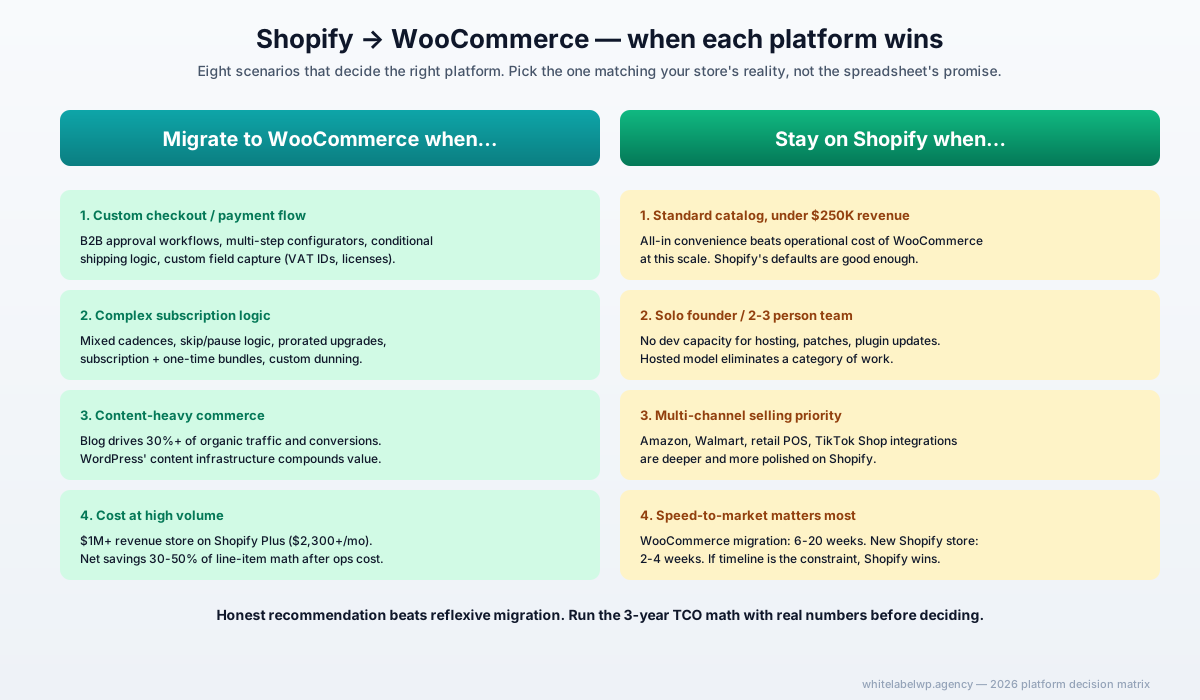
A Shopify to WooCommerce migration makes sense when the store needs custom checkout flows, complex subscription logic, deeper content integration, or lower per-transaction fees at high volume — and is willing to absorb the operational cost of running WordPress hosting and PCI compliance directly. For most stores under $250K annual revenue, Shopify’s all-in convenience usually wins; above $1M annual revenue with custom needs, WooCommerce often wins. The middle is a real decision that depends on team capacity, technical needs, and 3-year total cost of ownership.
The honest read: most “Shopify to WooCommerce” migration projects fail because the store didn’t actually need to migrate. The platform was fine; the team wanted control they couldn’t articulate why they needed.
TL;DR — when WooCommerce wins, when Shopify wins
| Scenario | Winner |
|---|---|
| Store under $250K annual revenue, standard needs | Shopify |
| Store needs custom checkout flow (e.g., quote-based, B2B approval) | WooCommerce |
| Store on Shopify Plus paying $2,300+/month with $1M+ revenue | WooCommerce (cost) |
| Subscription business with complex tier logic | WooCommerce |
| Multi-channel selling (Amazon + retail + DTC) | Shopify (better integrations) |
| Content-heavy commerce (publishing + selling) | WooCommerce |
| Solo founder or 2-3 person team | Shopify (less ops burden) |
| Marketing agency client where WP + Woo is the agency’s stack | WooCommerce |
The four scenarios where Shopify → WooCommerce makes sense
1. Custom checkout or payment flow requirements
Shopify’s checkout is famously rigid. Shopify Plus relaxes this somewhat with checkout extensibility, but the rigid model holds for most stores. WooCommerce, by contrast, lets you customize every field, every step, every conditional in the checkout flow.
Real scenarios where this matters:
- B2B stores needing approval workflows. Quote requests, net-30 invoicing, account-manager approval before order completion.
- Multi-step product configurators. Custom build configurators where the final price depends on 5+ user choices.
- Conditional shipping logic. Complex shipping calculations based on product type, destination, and customer tier.
- Custom field capture at checkout. Industry-specific fields like VAT IDs (EU), license numbers, certification details.
If the client’s product or business model can’t fit Shopify’s checkout, WooCommerce is genuinely the better platform — not because it’s cheaper, but because it can do the work.
2. Complex subscription or membership logic
Shopify’s native subscription functionality (Shopify Subscriptions) handles standard recurring billing well. It hits limits at:
- Mixed-cadence subscriptions (different products bill on different schedules)
- Skip-month or pause logic with member-controlled scheduling
- Prorated upgrades between subscription tiers
- Bundles of subscription + one-time products in a single order
- Custom dunning logic beyond Shopify’s defaults
WooCommerce Subscriptions, paired with WooCommerce Memberships, handles all of these natively. Our WooCommerce Subscriptions guide covers the deeper setup. For subscription businesses past the basic model, WooCommerce is structurally more flexible.
3. Content-heavy commerce (publishing + selling)
When the store is meaningfully a content site that also sells — a magazine that runs commerce, a creator with deep articles plus products, a brand with a high-volume blog driving organic traffic to products — WooCommerce inside WordPress wins. The content infrastructure (post types, taxonomies, editorial workflow, SEO controls) is native to WordPress. Shopify can host blogs but the editorial experience is meaningfully thinner.
Decision shortcut: if blog content drives 30%+ of the site’s organic traffic and conversions, WordPress + WooCommerce is the right architecture.
4. Cost at high volume (Shopify Plus economics)
Shopify Plus starts at $2,300/month in 2026, climbing to $40,000+/month for enterprise stores. A comparable WooCommerce setup (Kinsta or WP Engine commerce-tier hosting + premium plugins + payment gateway) runs $200-$800/month for the same traffic and order volume.
The annual delta is real: $18,000-$25,000/year for mid-volume stores, $300,000+/year for enterprise. But the savings get partially absorbed by:
- Operational time. Someone has to manage hosting, security patches, plugin updates, performance tuning. Plan 4-8 hours/week of senior time for a serious WooCommerce store.
- PCI compliance. Shopify handles PCI compliance as part of the platform. WooCommerce stores handle this themselves — usually via tokenization through Stripe or a comparable gateway, which keeps compliance scope manageable but still requires attention.
- Stack risk. Plugin conflicts, hosting issues, and emergency response are now the store’s problem, not Shopify’s.
Net savings after operational cost: usually 30-50% of the line-item math. Still real, still worth pursuing at scale — but smaller than the spreadsheet suggests.
The four scenarios where staying on Shopify wins
Be honest with the client about these:
- Standard product catalog, under $250K revenue. The all-in convenience of Shopify beats the operational cost of WooCommerce at this scale.
- Solo founder or 2-3 person team without dev capacity. Shopify’s hosted model eliminates a category of work that small teams can’t absorb.
- Multi-channel selling priority. Shopify’s integrations with Amazon, Walmart, retail POS, and TikTok Shop are deeper and more polished than WooCommerce’s. If multi-channel is the strategy, Shopify is structurally better.
- Speed-to-market matters more than control. A WooCommerce migration takes 6-20 weeks. A new Shopify store launches in 2-4 weeks. If the timeline is the constraint, Shopify wins.
Recommending the client stay on Shopify when the migration doesn’t make sense is what builds trust. Migration revenue isn’t worth a partnership that the client regrets in 18 months.
TCO comparison — 3-year math
For a $1M annual revenue store, 10,000 orders/year, 5,000 SKUs:
| Cost category | Shopify Plus (3 yrs) | WooCommerce (3 yrs) |
|---|---|---|
| Platform / hosting | $82,800 | $14,400-$28,800 |
| Apps / plugins | $7,200 (Shopify apps) | $2,000-$5,000 (WP plugins, mostly one-time) |
| Payment fees ($30M GMV × 2.9%) | $870,000 (Shopify Payments) | $870,000 (Stripe direct) |
| Custom dev / customization | $20,000-$50,000 | $30,000-$80,000 |
| Operational time (team) | Minimal | $40,000-$80,000 (4-8 hrs/wk @ $100/hr) |
| Migration cost (one-time) | N/A | $20,000-$50,000 |
| 3-year total | $980K-$1.01M | $976K-$1.09M |
The headline numbers come out close. The variability sits in operational time and migration cost. For stores with strong internal dev capacity, WooCommerce’s 3-year TCO comes in 5-15% lower. For stores without that capacity, Shopify often wins on TCO because the operational hidden cost on WooCommerce eats the platform savings.
Run this math with the client’s real numbers before recommending migration. The intuition that “WooCommerce is cheaper” is only sometimes true.
The migration playbook (high level)
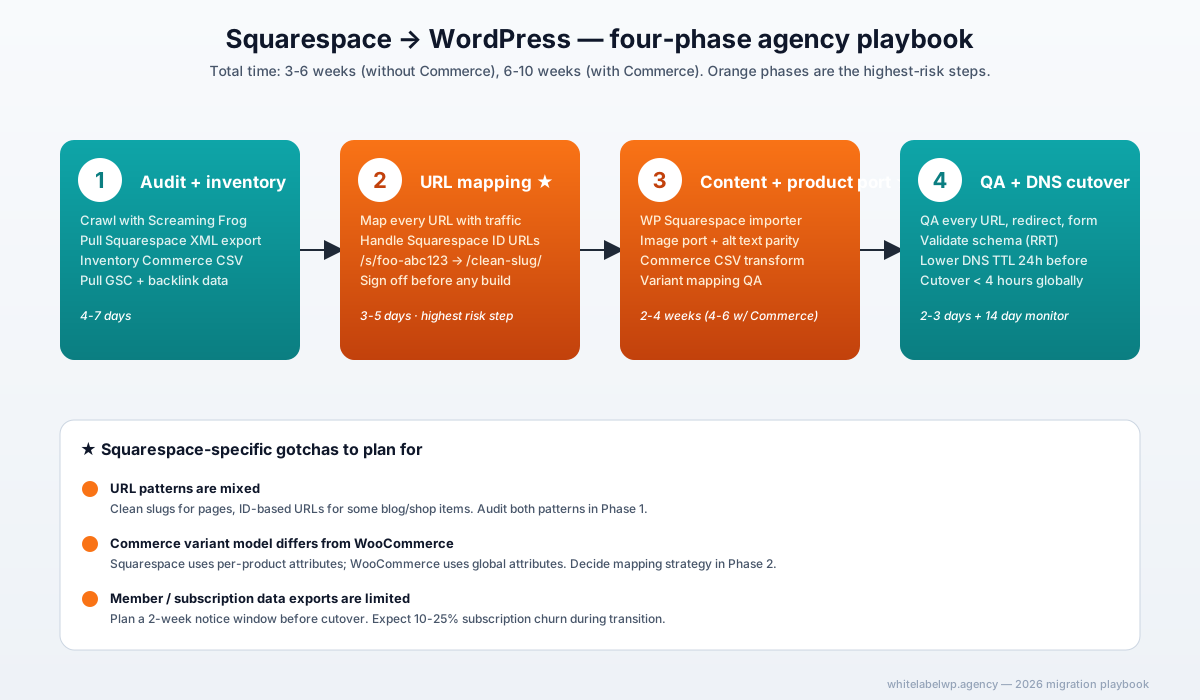
The detailed phase-by-phase work parallels the Squarespace to WordPress playbook. Shopify-specific differences:
Product and inventory migration. Shopify exports products as CSV. WooCommerce imports via WP All Import. The mapping is mostly clean but variant attributes (Shopify’s option1/option2/option3 model) need careful translation to WooCommerce’s global attribute system. SKUs preserve; product metadata mostly preserves; product images need re-uploading or referencing the new media library.
Customer data migration. Customer accounts export from Shopify with email, address, and order count. WooCommerce imports as customer accounts with a password-reset email at cutover. Payment tokens don’t transfer — returning customers re-enter card details on first order post-migration.
Order history. Usually skip. Shopify’s order data is too granular and tied to Shopify’s internal infrastructure to migrate cleanly. Most stores keep Shopify accessible read-only for 12 months post-cutover for historical lookups, then archive.
Payment gateway transition. Stripe (the most common gateway for both platforms) tokens don’t transfer between Shopify Payments and WooCommerce Stripe. Plan customer communication explaining the re-authorization step.
SEO preservation. Same 301 redirect discipline as any platform migration. Shopify uses /products/{slug} and /collections/{slug} URL patterns; WooCommerce defaults to /product/{slug} and /product-category/{slug}. Either align WooCommerce permalinks to match Shopify’s old structure, or set up 301s across the board. Map every URL with organic traffic.
What a Shopify to WooCommerce migration should cost
For a 100-500 product Shopify store without subscriptions, US agencies bill clients $15,000-$40,000 for the managed migration. Add $10,000-$30,000 for active subscription migration. Shopify Plus stores with custom apps, multi-location inventory, and complex tax setups run $50,000-$150,000.
White-label cost to the agency runs roughly 40-50% of the client price. Migrations of this complexity rarely fit inside a Pro retainer — they’re project-priced or absorbed into a Max tier retainer when the agency is running 1+ per quarter.
Smaller stores (under 50 products, no subscriptions, no custom apps) can fit a $6,000-$10,000 budget if the migration is genuinely straightforward — but those are also the stores most likely to be better off staying on Shopify.
Where White Label WP Agency fits
We run Shopify to WooCommerce migrations as a white-label service inside the agency’s brand. Our WooCommerce service covers the full migration plus the post-launch care that complex stores need (subscription monitoring, payment failure handling, plugin update discipline).
Before recommending a migration to any client, we run a 30-minute fit assessment — the four “Shopify wins” scenarios above are the screening filter. If the client fits one of those, we tell them so and don’t take the migration project. Honest recommendation is the entire business model.
Book a partner call if you have a Shopify migration in your pipeline and want a second opinion on whether the work makes sense.
Frequently asked questions
Should I migrate my Shopify store to WooCommerce?
Only if you have a specific requirement Shopify can’t meet — custom checkout, complex subscription logic, content-heavy commerce, or significant transaction fee savings at $1M+ revenue. For stores under $250K annual revenue with standard needs, Shopify’s convenience usually wins. The decision is operational (do you have the team to run WordPress hosting and PCI compliance) more than commercial.
How much cheaper is WooCommerce than Shopify Plus?
Shopify Plus starts at $2,300/month in 2026. A comparable WooCommerce setup (hosting + plugins + payment gateway) runs $200-$800/month for the same volume. The savings are real ($18K-$25K/year) but the operational cost (team time managing the stack, security patching, performance tuning) usually consumes 30-50% of the savings. Net advantage is real but smaller than the line-item math suggests.
How long does a Shopify to WooCommerce migration take?
For a typical 100-500 product Shopify store, expect 6-10 weeks. Larger stores with subscriptions, custom apps, or multi-location inventory run 12-20 weeks. The longest phases are product data transformation (Shopify’s structure differs from WooCommerce on variants and metafields) and payment gateway re-authorization for returning customers.
Will I lose Shopify customers in the migration?
Some, yes. Customer accounts migrate but payment tokens don’t — returning customers re-enter card details on first new order. Subscription customers face a re-authorization step. Plan for 5-15% subscription churn during the transition. Brand-new customers post-migration aren’t affected.
How much does a Shopify to WooCommerce migration cost in 2026?
For a 100-500 product Shopify store, US agencies bill clients $15,000-$40,000. Add $10,000-$30,000 for active subscription migration. Larger Shopify Plus stores with custom apps and multi-location inventory run $50,000-$150,000. White-label cost to the agency runs 40-50% of the client price.
Can WooCommerce handle the same volume as Shopify Plus?
Yes, with the right hosting and infrastructure. WooCommerce sites have processed $100M+ in annual GMV on properly configured stacks (managed WP hosting with object caching, Redis, dedicated database). The infrastructure cost at that volume runs $500-$2,000/month — well under Shopify Plus’s $2,300/month minimum.