What Does a White Label WordPress Agency Partnership Actually Cost?
Honest breakdown of what agencies pay white-label WordPress partners in 2026. Retainer ranges, hourly equivalents, hidden costs, and what's actually included.
White label WordPress partnerships in 2026 typically cost agencies between $599 and $8,000 per month, with the most common productive range falling at $1,000-$3,000/month for steady ongoing work (Web Help Agency 2026 industry pricing benchmark). The actual cost depends on three variables: dev hours per month, project complexity, and whether the engagement is hourly, project-based, or retainer-based. At White Label WP Agency our plans run $599/month (Lite), $1,099/month (Pro), and $1,999/month (Max).
The cheapest white-label partner is almost never the right one — but the most expensive isn’t either. The right one is the one whose pricing model matches your actual project flow.
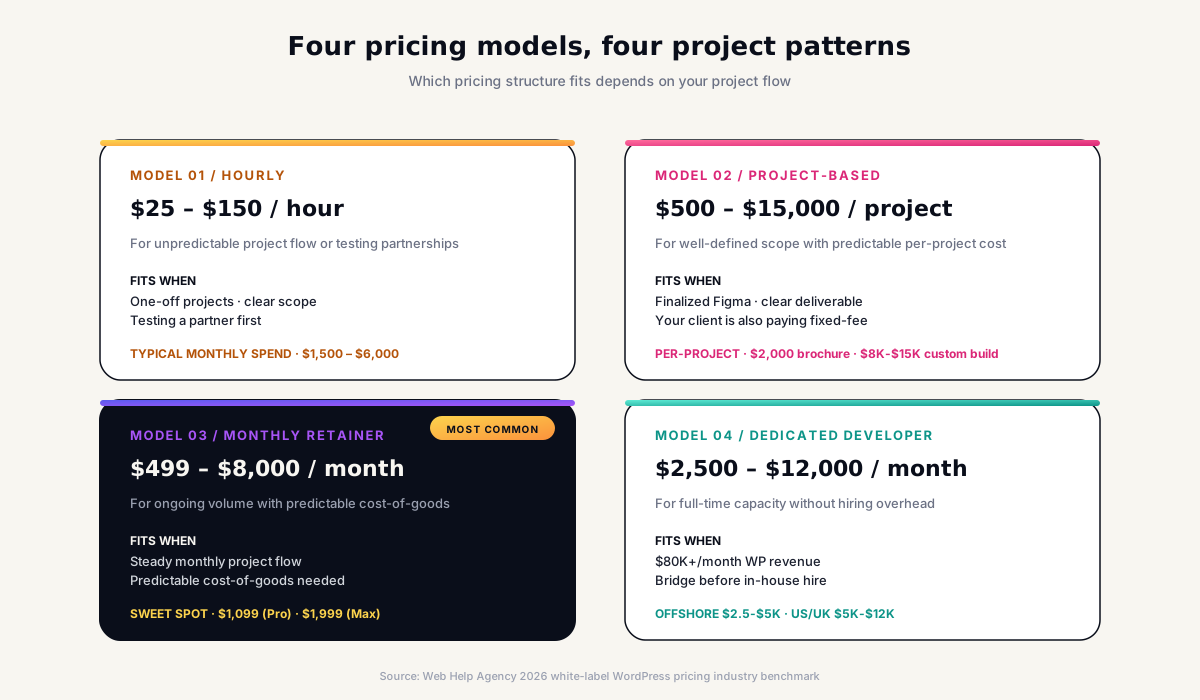
The four pricing models you’ll encounter
When you start evaluating white-label WordPress partners, you’ll see four pricing models in the wild. Each fits a different project pattern.
Model 1: Hourly billing ($25-$150/hour)
You pay for the hours the partner works, billed weekly or monthly. WPNearMe’s 2026 rate data puts entry-level white-label rates at $15-$40/hour, mid-level at $40-$80/hour, and senior at $80-$150+/hour.
Works well when: Your project flow is unpredictable, you have one-off projects with clear scope, or you’re testing a partnership before committing to a retainer.
Breaks when: You can’t predict monthly spend, partner availability isn’t guaranteed, and time-tracking disputes eat into the relationship.
Typical total cost: $1,500-$6,000/month for an agency with regular but irregular WordPress work.
Model 2: Project-based fixed pricing ($500-$15,000/project)
You agree on a flat fee for a defined scope. The partner absorbs the risk if it takes longer than expected; you absorb the risk if scope creeps.
Works well when: Project scope is very well defined (e.g., a brochure site with finalized Figma), you want predictable costs per project, and your client is also paying you on a fixed-fee basis.
Breaks when: Requirements change mid-project (and they always do), scope creep starts immediately, or the partner builds in 30%+ buffers that make every project feel overpriced.
Typical total cost: Wildly variable — $2,000 for a brochure site, $8,000-$15,000 for a custom build, $1,500-$3,500 for a migration.
Model 3: Monthly retainer ($499-$8,000/month)
You pay a fixed monthly fee for a guaranteed allocation of dev hours, regardless of whether you use them all. This is the model most established white-label partnerships run on.
Works well when: You have ongoing WordPress volume month-over-month, you want predictable cost-of-goods, your team can keep a partner busy steadily, and you value consistent delivery capacity over per-project optimization.
Breaks when: Your monthly volume is highly variable, you can’t fill the retainer hours consistently, or you don’t have brief discipline (hours burn on clarification cycles).
Typical total cost: $999-$3,000/month is the sweet spot for most agencies. Our retainer plans at $599 (Lite), $1,099 (Pro), and $1,999 (Max) sit at the agency-focused end of this range.
Model 4: Dedicated developer ($2,500-$12,000/month)
You essentially rent a full-time developer who works exclusively (or near-exclusively) on your account. The partner handles employment, benefits, and HR.
Works well when: Your WordPress volume justifies a full-time resource but you don’t want the hiring overhead. Often used by agencies in the $80K-$150K/month WordPress revenue band as a bridge between retainer and in-house hire.
Breaks when: The dedicated developer ends up under-utilized, your volume drops below the commitment level, or you want the operational benefits of in-house without the cost of a partner markup.
Typical total cost: $2,500-$5,000/month for an offshore dedicated developer, $5,000-$12,000/month for a US/UK-based dedicated resource.
What’s actually included in white-label retainer pricing
Before you compare retainer prices across partners, you need to understand that “monthly retainer” doesn’t mean the same thing at every agency. Web Help Agency’s 2026 industry breakdown identifies six components that should be included in a professional white-label retainer:
- Development time — the actual build, configuration, and testing hours
- Quality assurance — code review, cross-browser testing, mobile QA, performance benchmarking
- Project management — brief interpretation, revision coordination, staging handoff, documentation
- Staging environment — a separate build environment, often under your agency’s branded URL
- Handoff documentation — login credentials, plugin licenses, setup notes, all branded to your agency
- Post-launch support — typically 14-30 days of bug-fix coverage included in the project price
What’s typically NOT included (unless explicitly agreed):
– Plugin license costs (Elementor Pro, ACF Pro, WP Rocket, etc. — usually $300-$1,500/year per client site)
– Hosting (the client buys hosting directly)
– Third-party API fees (Stripe processing, Zapier subscriptions, etc.)
– Ongoing maintenance beyond the initial support period
A “retainer” that excludes QA or PM is not really a retainer — it’s just hourly billing with a minimum commitment. When evaluating partners, ask explicitly what’s included in the monthly price.
What agencies actually pay vs what they bill their clients
This is the part most pricing articles skip. There are two numbers in every white-label engagement: what you pay your partner, and what you bill your client. The gap between them is your margin.
Here’s a realistic 2026 example:
| Service | Client pays your agency | You pay white-label partner | Your margin |
|---|---|---|---|
| New WordPress site build (8-12 pages) | $5,000-$12,000 | $2,500-$6,000 | 50% |
| Monthly care plan (1 site) | $200-$500/mo | $40-$120/mo | 70-80% |
| Wix to WordPress migration | $3,500-$7,500 | $1,800-$4,000 | 45-50% |
| Custom plugin development | $4,000-$12,000 | $2,000-$6,000 | 50% |
| WooCommerce store build | $6,000-$15,000 | $3,500-$8,000 | 40-45% |
| Speed/CWV optimization (single site) | $800-$2,000 | $400-$900 | 50-55% |
The standard industry markup is roughly 2x. If your white-label partner charges you $2,500 for a build, you typically bill your client $5,000. The margin covers your sales effort, account management, PM overhead, brand premium, and profit.
Care plans run higher margins because the work is light, recurring, and the perceived value to the end client is high. Custom development runs slightly lower margins because the scope is harder to fix upfront and there’s more revision risk.
How to evaluate whether a partner’s pricing is fair
The dollar amount alone tells you almost nothing. Two retainers at $1,500/month can be wildly different in value. Here’s what to look at:
Effective hourly rate. Divide the monthly retainer by the included dev hours. White Label WP’s Pro plan at $1,099 for 55-60 hours = $18-$20/hour effective. Industry-fair range is $15-$35/hour effective for retainer-based pricing (lower than spot freelance rates because the partner is getting volume commitment).
Team structure. Who’s on your account? A retainer staffed entirely by junior developers is overpriced at $1,500/month. A retainer with a senior lead, a mid-level dev, and a PM is good value at $2,500.
Communication SLAs. Same-business-day response is standard. Under 4 hours for critical issues is good. Same-hour response is premium.
QA process. Is there a separate person reviewing code before delivery, or does the developer ship straight to your staging? The presence of a QA layer changes the value proposition substantially.
Specialization depth. Can the partner handle the breadth of your project mix (Bricks, Elementor, WooCommerce, custom dev, migrations) or are they a generalist?
Contract terms. Month-to-month is standard. Three-month minimum is common. Annual contracts should come with meaningful discounts (10-20%).
The hidden costs nobody discloses
Three costs that don’t appear on most partner pricing pages but should factor into your decision:
Onboarding time. The first month of any new white-label partnership is typically 30-40% under-productive while the partner learns your workflow, brand standards, and project conventions. Budget 1-2 weeks of internal time during onboarding for documentation and clarification cycles.
Brief refinement cycles. If your agency doesn’t have strong brief discipline, the first 60-90 days will see retainer hours burning on clarification rather than building. Some partners absorb this. Some charge for it. Ask upfront.
Transition costs. If you’re moving from one partner to another, you’ll spend roughly 2-4 weeks in overlap territory where both partners are partially engaged. Real cost: roughly 50-75% of one month’s retainer on each side.
What to ask before signing
Before you sign with any white-label partner, get clear answers to these questions:
- What’s specifically included in the monthly retainer (the six components above)?
- What hours can I expect — and what happens if work runs over?
- Who is the dedicated PM on my account, and how long have they been with the company?
- What’s the team structure (senior/mid/junior mix) on my account?
- What’s the average turnaround time on a standard request vs a complex one?
- What’s the response time SLA, and what defines a critical issue?
- Who owns the code at delivery — me, my client, or the partner?
- What’s the NDA situation, both ways?
- What happens if I want to exit the relationship — notice period, code handover, etc.?
- Can I see examples of the kind of monthly reports I’ll receive?
A partner that struggles to answer any of these is not ready for a serious agency engagement.
Where to go from here
If you’re trying to figure out which retainer tier or pricing model fits your specific situation, the fastest path forward is a 30-minute conversation about your current project mix and pipeline. Book a partner call and we’ll work through the numbers honestly — including telling you if our retainer model isn’t the right fit for where you are.
For a deeper look at how white-label cost stacks up against in-house hires, see our breakdown of white label vs in-house WordPress developer cost. If care plans specifically are what you’re scoping, our care service page has the full inclusion list.
Frequently asked questions
How much do agencies typically pay white-label WordPress developers in 2026?
The 2026 industry range is $499-$8,000/month for retainer-based partnerships. The most common productive range is $1,000-$3,000/month, where most established agency partnerships sit. Hourly rates run $25-$150 for direct hourly engagements, depending on developer experience level. White Label WP Agency’s three retainer tiers ($599, $1,099, $1,999/month) sit in the lower-mid range, priced for agencies under $100K/month in WordPress revenue.
What’s the minimum monthly budget for a serious white-label partnership?
Web Help Agency’s 2026 industry analysis puts the practical floor at $499-$749/month. Below that threshold, you’re typically getting freelancer-level work without the reliability infrastructure (dedicated PM, QA layer, NDA-protected delivery) that defines a real partner. White Label WP’s Lite tier at $599/month is positioned at this floor — it works for agencies with 1-2 active WordPress clients and steady but light volume.
Is project-based pricing or retainer pricing better for an agency?
Retainer pricing is better for ongoing volume; project-based pricing is better for one-off engagements. If you have 3+ WordPress clients with monthly maintenance needs plus 1-2 new builds per quarter, a retainer is almost always the more economical and operationally cleaner choice. If you’re testing a partner with a single defined project, fixed project pricing makes sense for the initial engagement.
How much margin do agencies typically make on white-label WordPress work?
The industry standard markup is roughly 2x — you bill your client approximately twice what you pay the white-label partner. Margins vary by service type: care plans run 70-80% margin because the work is light and recurring, builds run 40-50% margin because the scope is harder to fix upfront, and custom development runs 45-55% margin depending on complexity and revision risk.
What’s typically NOT included in a white-label WordPress retainer?
Most retainers exclude: plugin licenses (Elementor Pro, ACF Pro, WP Rocket, etc., usually $300-$1,500/year per client site), hosting costs (the end client buys hosting directly), third-party API fees (Stripe, Zapier subscriptions), and ongoing maintenance beyond the initial post-launch support window (usually 14-30 days). These costs typically remain with the agency or pass through to the end client at cost.
Can I negotiate pricing with a white-label WordPress partner?
Yes, and you should. Web Help Agency’s 2026 analysis notes that partners will typically discount 10-20% for agencies committing to 3+ projects per month or a 6-month minimum retainer. Scope clarity is another lever — a fully detailed brief with Figma files, feature list, and integration spec reduces partner risk and often results in a lower per-project quote. Annual prepayment in exchange for 10-15% discount is also common.
How do I compare two white-label retainer quotes fairly?
Don’t compare monthly dollar amounts directly — compare effective hourly rates. Divide the monthly retainer by the included dev hours: a $1,500/month retainer with 50 hours is $30/hour effective; a $2,000/month retainer with 90 hours is $22/hour effective. Then add up the qualitative factors: team structure, communication SLA, QA process, specialization depth, contract terms. The lower hourly rate isn’t always the better deal if it comes with weaker process infrastructure.