White Label vs In-House WordPress Developer: The Real Cost Math
The full 2026 cost math for white-label vs in-house WordPress development. Salaries, retainers, hidden costs, breakeven points — based on real industry data.
White-label WordPress development typically costs 40-60% less than equivalent in-house capacity for agencies billing under $80,000/month in WordPress revenue. The breakeven point where in-house starts to win is approximately 12-15+ billable projects per month at full utilization (Web Help Agency, 2026). Below that threshold, the fixed-cost commitment of a full-time hire — $110,000-$155,000 loaded annually for a US/UK mid-level developer — consistently underperforms a variable-cost retainer model on both margin and operational risk.
The agencies that get this wrong are the ones who treat the hiring decision as “should we hire?” instead of “what’s our project volume at 12 months from now?” — those are two different questions.
What this article is going to do
I’m going to walk you through the actual cost math for both models, using current 2026 industry data. No marketing spin, no “it depends” hand-waving — just the numbers and the conditions under which each model wins. By the end, you’ll be able to plug your own agency’s WordPress revenue into the framework and see clearly which model fits your situation.
A note before we start: every dollar figure here uses 2026 US market data. If you’re an agency in the UK, Australia, EU, or India, the absolute numbers shift but the relative comparison holds. Indian in-house salaries run 40-60% of US rates, but so do most white-label partner costs. The ratios stay roughly consistent.
The in-house developer’s true cost in 2026
Most agency owners think about hiring as “I’ll pay them $X salary.” The actual cost is roughly 1.6-1.9x the base salary once you include all the loading factors. Here’s the breakdown.
Base salary
For a mid-level WordPress developer in the US, the 2026 baseline is:
| Region | Mid-level salary | Source |
|---|---|---|
| US national average | $84,542/year | ZipRecruiter via WPNearMe |
| US (NYC, SF, LA) | $95,000-$130,000 | WPNearMe metro analysis |
| UK | £60,000-£90,000 ($75K-$113K USD) | Industry standard |
| EU (Western) | €55,000-€80,000 ($59K-$86K USD) | Glassdoor 2026 |
| Eastern Europe | $35,000-$55,000 | Stack Overflow 2026 |
| India | $18,000-$35,000 | Glassdoor India 2026 |
| Philippines | $15,000-$30,000 | Payscale 2026 |
For this analysis I’ll use the US mid-level figure of $100,000 base salary as a working number. It’s a reasonable middle-ground for the US/UK/EU developer market that most agencies are hiring from.
Benefits, payroll tax, and overhead
The standard loading is 20-30% on top of base salary. Web Help Agency’s 2026 benchmark uses 20-30%, which matches what most US agencies report internally.
On a $100K base salary, that’s $20,000-$30,000 in:
- Employer payroll tax (FICA, FUTA, SUTA, state unemployment): roughly 7.65-8.5%
- Health insurance contributions: $6,000-$15,000 depending on plan
- Retirement match (if offered): typically 3-6% of salary
- Equipment, software, tools: $2,500-$5,000/year (laptop refresh cycle, Adobe, plugins, hosting)
- Office space if applicable: variable, but $3,000-$8,000/year in remote-friendly markets
Loaded direct cost: $120,000-$130,000/year
Recruiting cost (often hidden)
Most agencies don’t account for this until they’ve done it. Filling a WordPress developer role typically costs:
- Job board fees (LinkedIn, Indeed, We Work Remotely, etc.): $500-$2,000
- Recruiter fees if used: 15-25% of first-year salary = $15K-$25K
- Internal time (screening, interviewing): 20-40 hours of senior staff time = $2,000-$8,000 in opportunity cost
- Tools (Calendly, ATS, background checks): $500-$1,500
Even if you don’t use a recruiter, the lost productivity of senior staff during the search process is real cost. Average across multiple hires: $5,000-$15,000 per filled role, amortized over the developer’s tenure (typically 2-3 years).
Onboarding ramp time
A new WordPress developer doesn’t deliver at full capacity from day one. The typical ramp curve:
- Month 1: ~30% effective output (learning codebase, tooling, agency processes)
- Month 2: ~60% effective output
- Month 3: ~80% effective output
- Month 4+: Full productivity
Across the first three months, that’s roughly 50% lost output. At a $120K loaded annual cost, the first three months cost you $30K but produce $15K of value. Lost ramp value: $15,000. Amortized over 2-3 year tenure: ~$5,000-$7,500/year.
Management overhead (the biggest hidden cost)
For owner-operators of agencies under 25 people, managing a developer takes 4-8 hours per week. That’s:
- 30 min/day on standups, async check-ins, Slack
- 1-2 hours/week on code review and architectural decisions
- 30 min/week on 1:1s
- 1-2 hours/month on performance reviews, professional development
- Variable time on capacity planning, project assignment, escalations
If the owner’s billable rate is $100-$200/hour (typical for agency owners), that’s $20,000-$40,000/year in opportunity cost that should appear on the in-house developer’s true cost ledger.
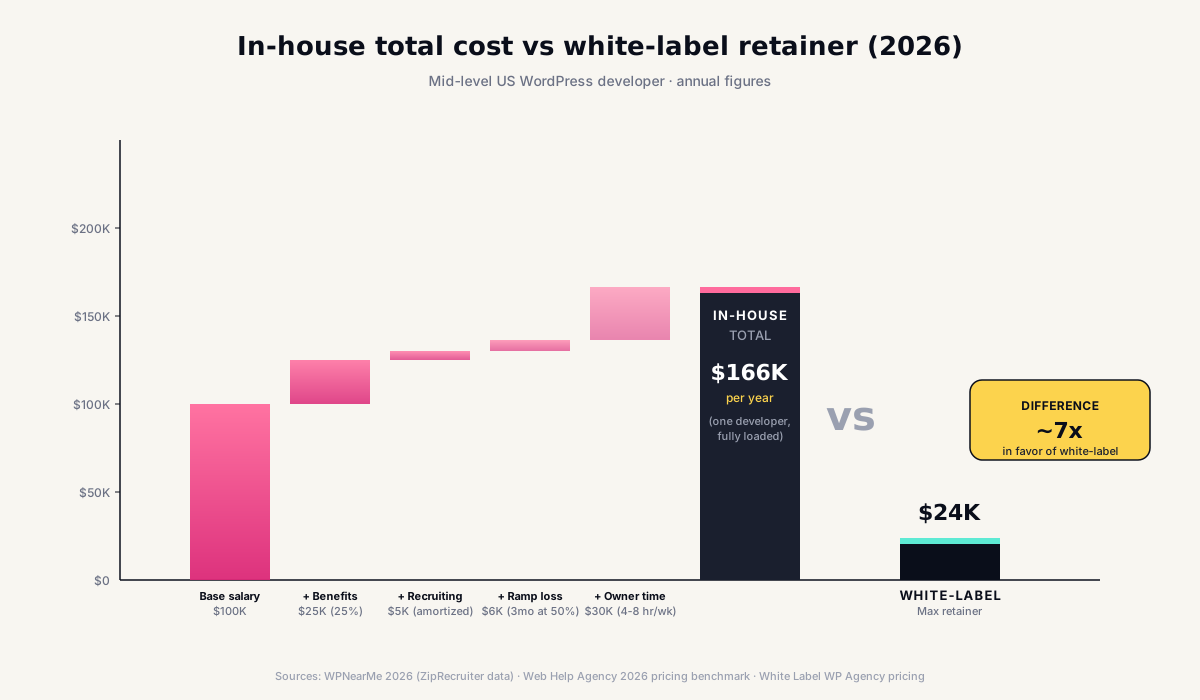
Total loaded cost of an in-house mid-level WordPress developer (US/UK)
Adding it up:
| Cost component | Annual amount |
|---|---|
| Base salary | $100,000 |
| Benefits + overhead (25%) | $25,000 |
| Recruiting (amortized) | $5,000 |
| Onboarding ramp (amortized) | $6,000 |
| Management time | $30,000 |
| TOTAL LOADED COST | $166,000/year |
That’s one developer. For a working WordPress agency team — typically a senior, a mid-level, and a junior — the total annual cost is $350,000-$500,000+ when fully loaded. This is the number most agency owners don’t realize they’re committing to when they say “we should hire someone.”
What in-house actually buys you that white-label doesn’t
Before going further, I should be honest that in-house has real advantages. The cost math is only one side of the comparison.
What in-house wins on
Deep institutional knowledge. An in-house developer who’s been with your agency for two years knows every client’s quirks, every codebase’s history, every internal preference. White-label partners rebuild some of this every year as account managers rotate.
Real-time collaboration. Same Slack, same timezone (if you hire locally), same standups. For agencies that work very iteratively with clients (“Hey, can we change the homepage hero by EOD?”), in-house responsiveness is hard to beat.
Cultural alignment. Your in-house developer is part of your team. They go to team retreats, they’re in the company Slack, they know your clients by name. White-label partners are professional partners, not teammates.
Custom processes. If your agency has unique workflows — proprietary client portals, custom QA processes, specific code conventions — in-house developers internalize these faster than external partners.
Capacity guarantees. When an in-house developer is on payroll, you have their hours. When a white-label partner is at capacity, you may need to wait.
These are real benefits. They’re worth real money. The question is whether they’re worth the $166K/year per developer that you’re paying for them.
The white-label retainer cost in 2026
Now the other side. Web Help Agency’s 2026 industry pricing benchmark puts white-label WordPress retainers at $1,500-$8,000/month across vendors globally, with the most common range being $1,500-$5,000/month for productive ongoing partnerships.
At White Label WP Agency, our 2026 pricing:
| Plan | Monthly cost | Dev hours/month | Annual cost |
|---|---|---|---|
| Lite | $599 | 25-30 | $7,188 |
| Pro | $1,099 | 55-60 | $13,188 |
| Max | $1,999 | 110-120 | $23,988 |
Pro is the most common starting point for agencies with established WordPress revenue. Max approximates the capacity of one full-time mid-level developer (assuming ~120 productive hours/month, which matches the realistic output of a full-timer once you back out meetings, planning, and management overhead).
So the apples-to-apples comparison is:
- In-house mid-level developer: $166,000/year loaded cost
- Max retainer (equivalent capacity): $23,988/year
That’s a ~7x cost difference for roughly equivalent dev hours. The difference is partly that the retainer doesn’t include the management overhead, recruiting, or ramp costs — those are absorbed by the white-label partner.
When in-house actually beats white-label
The crossover happens around 12-15 concurrent billable projects per month at full utilization, per Web Help Agency’s benchmark. Let me unpack what that means in agency revenue terms.
If your average WordPress project bills $4,000 (a reasonable mid-market figure), 12-15 projects/month is $48,000-$60,000/month in WordPress revenue, or roughly $575,000-$720,000/year in WordPress revenue alone.
At that volume:
– You can fully utilize an in-house developer (and probably a small team)
– The fixed cost of in-house gets amortized over high project volume
– You have the operational maturity to manage developers
– You have the pipeline consistency to justify the commitment
Below that threshold, you’re paying for fixed capacity you can’t fill. Even at 8-10 projects/month, an in-house developer is often 30-40% under-utilized — that under-utilization is pure cost with no offsetting revenue.
Two real scenarios, side by side
Let me run the math on two realistic agency situations.
Scenario A: Marketing agency, $30K/month WordPress revenue
Project mix: 6-8 active WordPress projects per month. Mix of new builds (~30%), care plans (~40%), and ad-hoc development (~30%).
In-house option (one mid-level developer):
– Loaded annual cost: $166,000
– WordPress revenue: $360,000
– Gross margin: $194,000 (54%)
– Capacity utilization: ~70% (under-utilized)
– Owner management time: 4-6 hours/week
White-label option (Pro retainer at White Label WP):
– Annual cost: $13,188
– WordPress revenue: $360,000
– Gross margin: $346,812 (96% — but this is before allocated overhead from your own PM/sales staff)
– Capacity utilization: 90%+ (you scale up/down as needed)
– Owner management time: <1 hour/week
Winner: White-label, by approximately $150,000/year in retained margin plus 200+ hours of recovered owner time.
Scenario B: Specialized WordPress agency, $90K/month WordPress revenue
Project mix: 15-20 active projects/month. Heavy custom development, complex WooCommerce builds, and recurring care for 25+ enterprise clients.
In-house option (3-developer team: senior + mid + junior):
– Senior loaded: $220,000
– Mid loaded: $166,000
– Junior loaded: $95,000
– Total team cost: $481,000
– WordPress revenue: $1,080,000
– Gross margin: $599,000 (55%)
White-label option (multiple Max retainers):
– 4x Max retainers at $1,999/mo = $95,952/year
– Roughly equivalent capacity (~500 dev hours/month)
– WordPress revenue: $1,080,000
– Gross margin: $984,048 (91%)
– But: less institutional knowledge, more coordination overhead, capacity ceiling
Winner: White-label still wins on margin by $385,000, but the practical gap narrows because at this volume, the agency needs to start questioning whether they’re a “marketing agency with WordPress capability” or a “WordPress agency that does marketing.” If it’s the latter, hiring becomes strategic.
The middle ground most agencies actually live in
Most agencies aren’t in Scenario A or Scenario B. They’re somewhere in between — $15K-$60K/month in WordPress revenue, with uneven project volume month-to-month, and an owner who wants to spend less time managing delivery.
In this band, the realistic options are:
Option 1: Stay on freelancers. Works if you have 3+ reliable freelancers and can absorb the occasional ghosting. Most economical, highest risk.
Option 2: Single white-label retainer (Pro tier). Covers 60-80% of monthly needs, with freelancers as overflow. The most common pattern we see.
Option 3: White-label retainer + part-time freelancer. Pro tier for steady-state work, freelancer for specialist projects (custom plugins, complex migrations). Roughly $1,500-$2,500/month all-in.
Option 4: Hire a single mid-level developer. Only makes sense if you have $60K+/month in WordPress revenue and consistent pipeline. Below that, you’re paying for under-utilization.
The decision framework
If you’re trying to decide which model is right for your agency, here’s the practical framework:
Choose freelancers if:
– Monthly WordPress revenue is under $15,000
– Project mix is simple (mostly brochure sites, page builder work)
– You have 3+ reliable freelancers you’ve worked with for 6+ months
– You can absorb occasional quality or timing issues
Choose a white-label retainer if:
– Monthly WordPress revenue is $15,000-$80,000
– Project mix varies (builds, care, custom work, migrations)
– You want consistent capacity with no management overhead
– You’d rather spend your time on sales and strategy than on dev management
Choose in-house if:
– Monthly WordPress revenue is consistently above $80,000
– Project mix is concentrated in 2-3 areas a generalist can cover
– You have operational maturity to manage technical staff
– You have 12+ months of consistent pipeline visibility
Choose a hybrid (retainer + in-house) if:
– Monthly WordPress revenue is $80K-$150K and growing
– You have specialist needs that don’t justify another full-time hire
– You want to test market positioning as “the WordPress agency” before committing fully
What to do next
If you’ve worked through the math and the white-label retainer model looks like a fit, the next step is a 30-minute conversation about your specific situation. We’ll look at your project mix, your monthly volume, and tell you honestly whether our retainer plans fit — or whether you’re closer to the in-house breakeven than the math suggests.
Book a partner call, or if you want to keep reading first, our deep dive on how to scale a WordPress agency without hiring walks through the operational playbook.
Frequently asked questions
What is the average cost of an in-house WordPress developer in 2026?
The average US-based mid-level WordPress developer earns $84,542/year in base salary (ZipRecruiter 2026 data via WPNearMe), with senior developers commanding $80-$150/hour or $130,000+/year. Once you include 20-30% in benefits and overhead, the fully loaded cost of a mid-level developer is approximately $110,000-$155,000/year (Web Help Agency 2026 industry benchmark). Adding management overhead and recruiting/ramp costs typically brings true annual cost to $160,000-$200,000.
How much does a white-label WordPress retainer typically cost?
White-label WordPress retainers across the industry range from $499/month at the entry point to $8,000/month for high-volume plans. The most common productive range is $1,500-$5,000/month. At White Label WP Agency our plans are $599/month (25-30 dev hours), $1,099/month (55-60 hours), and $1,999/month (110-120 hours), priced specifically for digital, marketing, and SEO agencies handling steady WordPress volume.
At what revenue level does hiring an in-house WordPress developer make sense?
Approximately $60,000-$80,000/month in consistent WordPress revenue is the breakeven point where in-house starts to compete with white-label on cost. Web Help Agency’s 2026 industry analysis puts the operational breakeven at “12-15 billable projects per month at full utilization” which maps to roughly $48K-$60K/month in revenue. Below that threshold, in-house developers are typically 30-40% under-utilized, and the fixed cost commitment underperforms a variable-cost retainer.
Can I use both white-label and in-house developers at the same time?
Yes, and it’s actually a common operational model for agencies in the $80K-$150K/month WordPress revenue band. The typical structure: one in-house developer (often a senior) handles strategic and complex work, while a white-label retainer absorbs steady-state care plans, smaller builds, and overflow capacity. This hybrid model gives you institutional knowledge from the in-house hire and variable cost flexibility from the retainer.
What hidden costs do agencies overlook when hiring in-house?
The three most commonly under-counted costs are: management time (4-8 hours/week of owner time at $100-$200/hour opportunity cost = $20-$40K/year), recruiting and onboarding (typically $5K-$15K amortized over the hire’s tenure), and ramp time productivity loss (50% reduced output in the first 90 days = roughly $15K in lost value on a $120K loaded salary). Combined, these add 30-40% to the true cost above the simple “salary + benefits” calculation.
Is white-label always cheaper than in-house?
No. Above $80,000/month in consistent WordPress revenue with concentrated specialization needs, in-house typically wins on total cost of ownership and operational control. The cost advantage of white-label is most pronounced in the $15K-$60K/month band where in-house developers would be under-utilized. Above that band, the comparison narrows and other factors (cultural fit, institutional knowledge, strategic depth) often matter more than per-hour cost.
How long does it take to ramp up a white-label partner vs hiring in-house?
White-label retainers typically reach full productive output in 30-60 days, compared to 90-180 days for in-house hires. The faster ramp is because the partner already has WordPress expertise, internal processes, and a delivery infrastructure — they just need to learn your agency’s specific brief format, communication style, and quality standards. In-house hires have to learn all of those plus build relationships with your existing team, clients, and workflows from scratch.