How to Scale a WordPress Agency Without Hiring More Developers
The honest playbook for scaling a WordPress agency past 6-figure revenue without hiring full-time devs. Real cost math, retainer models, and what actually works.
You can scale a WordPress agency past $30K-$50K in monthly revenue without hiring a single full-time developer. The leverage point is a flat-monthly white-label partner who absorbs delivery while you keep client relationships, margin, and brand. In 2026, with mid-level US WordPress developers costing $80,000-$120,000/year in salary plus 20-30% in overhead (Web Help Agency, 2026), the math now consistently favors fractional delivery up to roughly 12-15 concurrent projects per month — well past the ceiling where most agencies feel they “have to hire.”
If you’re closing more work than your current team can deliver, hiring is almost never the right first move. It’s the third move.
The hiring trap most agency owners walk into
Here’s the pattern. You hit a quarter where pipeline is strong, your one or two freelancers are stretched, and a client just signed a six-month retainer that needs steady WordPress delivery. The obvious move is to hire a developer. Job posted, interviews start, three weeks pass, you make an offer, two more weeks of notice period, and now you have someone — six weeks after you needed them — and they’re billing you whether the pipeline holds or not.
Then comes the second problem. Your new hire is good at one thing, maybe two. The senior dev who can architect a custom plugin probably isn’t your best WooCommerce checkout person, who isn’t your best Bricks Builder pixel-perfect implementer, who isn’t your fastest Wix-to-WordPress migrator. Agencies that hire WordPress generalists end up either accepting weaker delivery on edge cases or hiring two more specialists to cover gaps. Each hire compounds the management overhead.
In our experience working with 150+ agency partners, the hiring trap shows up in three flavors:
The premature hire. You hire to meet pipeline that doesn’t hold for the next six months. You’re now paying $7,000-$13,000/month fully loaded for a developer with intermittent work. You laid them off in nine months and spent twelve weeks of recruiting time you’ll never get back.
The specialist gap. You hired a generalist who’s competent at 70% of what your pipeline demands, but the remaining 30% (WooCommerce edge cases, custom plugin work, complex migrations) still goes to a freelancer or sits unaddressed. Now you’re paying full-time for partial coverage.
The management drag. Even when the hire works out, you’re spending 4-8 hours a week on management — 1:1s, code reviews, ticket triage, capacity planning. That’s a quarter of your work week being absorbed by a function you weren’t doing before. For owner-operators, this is usually the most expensive cost in the entire model.
The real cost of an in-house WordPress developer in 2026
Let’s actually put the numbers on the table. Honest math beats rough intuition every time.
According to WPNearMe’s 2026 rate analysis, citing ZipRecruiter data, the US national average WordPress developer salary is $84,542/year. Web Help Agency’s 2026 pricing breakdown puts the loaded annual cost of a mid-level US or UK WordPress developer at $110,000-$155,000 when you include the 20-30% in benefits, equipment, training, and overhead on top of base salary.
That’s just the direct cost. Add the indirect costs and the picture sharpens:
| Cost category | Annual amount | Notes |
|---|---|---|
| Base salary (mid-level US) | $80,000-$120,000 | WPNearMe 2026 |
| Benefits, payroll tax, equipment | $16,000-$36,000 | 20-30% loading |
| Recruiting cost (1x/year average) | $5,000-$15,000 | Lost productivity + tools |
| Onboarding ramp (3 months at 50%) | $10,000-$15,000 | Productivity loss |
| Management time (4-8 hr/week of owner) | $20,000-$40,000 | If owner’s billable rate is $100-$200/hr |
| Total loaded annual cost | $131,000-$226,000 | One developer |
That’s one developer, not a team. To handle the full WordPress service surface — builds, themes, WooCommerce, custom plugins, migrations, care — you’d realistically need three to four specialists. Call it $400K-$700K/year in fully loaded cost for a small in-house team. At a 30% gross margin on WordPress delivery, that means you need $1.3M-$2.3M in WordPress revenue just to break even on the team. Most digital and marketing agencies under $5M never get there because WordPress is one service in a broader mix, not the whole business.
The alternative is fractional delivery — paying only for the dev hours you actually need, with no overhead, no management, no recruiting, no ramp.
What “scaling without hiring” actually means
Let’s be specific. Scaling without hiring doesn’t mean working harder, taking on cheaper clients, or jamming more work through your existing freelancer. It means restructuring delivery around three principles:
Convert delivery from a fixed cost to a variable cost. Instead of paying for a developer whether you have work or not, pay for capacity proportional to your pipeline. White-label retainers do this natively.
Specialize the partner, not the hire. A good white-label partner has people who specialize in WooCommerce, in Bricks Builder, in migrations, in custom plugin development — and you get access to the right specialist for each project without hiring six people.
Remove yourself from delivery management. Your time as the owner is worth more in sales, account management, and strategy than in code review and ticket triage. A white-label partner with a dedicated PM means your management overhead drops to a weekly Slack check-in.
Get those three right and your agency’s revenue ceiling isn’t your team’s capacity — it’s your ability to sell. Most agencies under $5M are sales-limited, not delivery-limited, but they don’t realize it until they remove the delivery drag.
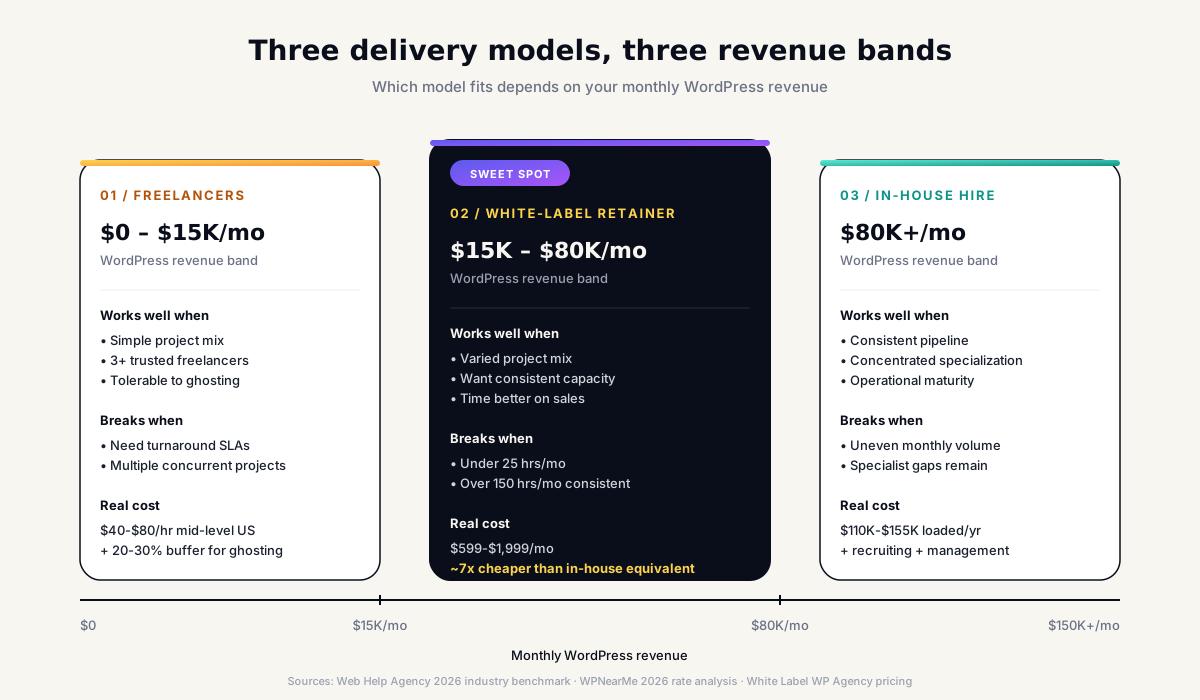
The three models for scaling delivery — what each actually costs
There are three viable paths to scaling WordPress delivery. Each has a fit, and each has a sweet spot in agency revenue.
Model 1: Freelancers (works up to ~$15K/mo WordPress revenue)
The starting model. You have a Slack channel with two or three trusted freelancers, you pay them per project or per hour, and you hope they’re available when you need them.
Works well when: Your WordPress revenue is under $15K/month, your project mix is simple (mostly brochure sites or page builder work), and you can absorb the occasional ghosting or quality issue.
Breaks when: You need consistent turnaround SLAs. Freelancers ghost — not because they’re bad people, but because life happens, queues stack, one big client pulls their focus. Invedus’ 2026 pricing analysis notes that freelance rates have inflated 15-25% in two years, partly because the reliable freelancers are increasingly booked through agencies, leaving thinner availability for direct hires.
Real cost: $40-$80/hour for mid-level US freelancers, but the hidden cost is the 20-30% buffer you have to build into every client estimate because you don’t actually know if the work will ship on time.
Model 2: In-house hire (works above ~$80K/mo WordPress revenue)
The traditional “scale up” move. You have enough consistent pipeline that paying for full-time capacity makes economic sense.
Works well when: You have $80K+/month in WordPress revenue (about $1M/year), your project mix is concentrated in 2-3 areas a single developer can cover, and you have the operational maturity to manage people.
Breaks when: Your pipeline isn’t consistent month-over-month, your project mix needs specialists (e.g., one month is heavy WooCommerce, next month is custom plugin work), or you can’t justify the management overhead.
Real cost: $110K-$155K all-in for a mid-level US/UK developer (Web Help Agency 2026), $60K-$80K for a senior developer in Eastern Europe or Latin America, $30K-$50K for India-based talent. Add 30% for management, recruiting, and ramp time.
Model 3: White-label retainer (the missing middle, ~$15K-$80K/mo revenue)
The model most under-served by the industry. You pay a flat monthly fee for a dedicated WordPress delivery pod that handles your project queue under your agency’s brand. No hiring, no management, no commitment beyond a month at a time.
Works well when: Your WordPress revenue is between $15K-$80K/month, your project mix is varied (builds, care, migrations, occasional custom work), and your time is better spent on sales and account management than delivery.
Breaks when: Your monthly volume is so low (under 25 dev hours/month) that even the smallest retainer is more capacity than you need, or so high (150+ dev hours/month consistently) that you’ve outgrown the retainer model.
Real cost: $599-$1,999/month at White Label WP Agency. Web Help Agency’s industry benchmark puts most white-label WordPress retainers in the $1,500-$8,000/month range across vendors globally.
This is the band where most digital, marketing, and SEO agencies operate, and it’s also where the math most cleanly beats both freelancers and in-house hires.
When the white-label model wins — the honest math
Let me walk through the actual breakeven on a real agency situation, because abstract numbers don’t help.
Scenario: A marketing agency with three ongoing WordPress clients. Each client is $3,000/month retainer (combining hosting, maintenance, and ad-hoc updates). The agency closes one new build per quarter at an average of $8,000.
Annual WordPress revenue: $108,000 (retainers) + $32,000 (builds) = $140,000/year.
If they hire in-house:
- Mid-level US developer: $130K loaded annual cost
- Gross margin on WordPress: $10K
- Effective profit: After management time, recruiting amortization, ramp loss — likely negative
If they use freelancers:
- ~700 dev hours needed annually at $60/hr blended = $42K
- Gross margin on WordPress: $98K
- But: client churn risk from quality issues, ghosting, missed deadlines — historically ~15% revenue loss/year on this model
If they use a Pro-tier white-label retainer ($1,099/mo, 55-60 hours/month):
- Annual cost: $13,188
- Capacity: ~660-720 hours/year (matches their needs)
- Gross margin on WordPress: $127K
- Plus: consistent delivery, dedicated PM, no management drag, no churn risk
The white-label retainer wins by $85K-$117K/year in this scenario. And that’s before counting the owner’s time saved — which, at $150/hr opportunity cost, adds another $30K-$60K/year in recovered capacity for sales and strategy work.
The math doesn’t work for every agency. If your WordPress revenue is under $5K/month, a retainer is overkill — stick with freelancers. If your WordPress revenue is over $80K/month and steady, you’ve earned the in-house move. But the middle band is wide, and most agencies are in it.
The four things you need to be ready for white-label work
Before you sign with any white-label partner, your agency needs to have these four operational pieces in place. Skipping any of them turns the retainer from a multiplier into a frustration.
1. A documented delivery workflow
Your PM, designer, and account managers need to know how a project moves from “client said yes” to “shipped on staging.” The white-label partner plugs into that workflow — they don’t replace it. If your current workflow is “Slack me when something needs doing,” you’ll churn through partners until you build one.
Minimum viable workflow: a Trello/Asana/ClickUp board with a “Brief incoming” column, a “Brief approved” column, an “In dev” column, a “Ready for QA” column, and a “Ready to launch” column. Every project, every time.
2. Brief discipline
The single biggest predictor of white-label retainer success is brief quality. A good brief contains: the design (Figma/XD/PSD link), the content (drafted, not “we’ll figure out later”), the integrations required (forms, CRM, payment gateway, analytics), the success criteria, and the deadline.
If your team is in the habit of saying “we’ll figure out the rest as we go,” the retainer hours will burn on clarification cycles instead of building. Most agencies need to spend the first 30-60 days with a white-label partner improving their brief discipline. After that, throughput compounds.
3. A way to handle client communication that doesn’t break confidentiality
The white-label partner is invisible. That means your team handles all client-facing communication. If your client emails about a bug at 9 PM, your PM gets that email — not the developer who’ll fix it. You translate the bug report into a ticket, the developer fixes it, you reply.
This requires your team to be the brand-facing layer at all times. Some agencies set up a shared Slack between their PM and the white-label PM specifically to keep the relay tight without exposing internal communications.
4. A retainer-priced relationship with your own clients
If you’re billing your clients hourly for WordPress work, the white-label retainer model fights against your revenue model. Convert client billing to monthly retainers or fixed-scope projects first. Then a white-label retainer becomes a clean cost-of-goods on top of recurring revenue.
The agencies that get the most out of white-label partnerships are the ones that have already converted 60%+ of their WordPress revenue to recurring retainers with their own clients. That’s not a coincidence — the model only works when both sides of the relationship are monthly.
What can actually go wrong (and how to prevent it)
White-label retainers are not magic. Here’s where they break, and the structural prevention for each.
Communication lag. If your white-label partner is in a 9-hour different timezone, urgent issues can get a 24-hour response cycle. Prevention: build in async expectations, agree on a daily check-in window that overlaps both timezones (even 30 minutes is enough), and use Slack/PM tools instead of email.
Scope creep within retainer hours. Without good tracking, retainer hours leak. Three “quick fixes” become eight hours. Prevention: weekly hours report from the partner, monthly review, and a clear policy on what happens when hours run over (overflow into next month, billed separately, or capped).
Quality plateaus. A junior developer on your account every month means you’ll plateau at junior quality. Prevention: ask for the team structure upfront — who’s your dedicated PM, who’s your lead dev, what’s the QA layer. Senior involvement matters most on first projects and complex builds; junior involvement is fine for steady-state care work.
The “we’re invisible” trap. A partner who’s truly invisible can also be hard to evaluate. You don’t see them work, you only see deliverables. Prevention: monthly performance reviews, request access to staging environments, and watch the commits if you have GitHub access.
Vendor lock-in. What happens if you need to exit the relationship? Prevention: insist on full code ownership in the contract, written into the NDA. Repo access, credentials, plugin licenses — all yours from day one. Our build process explicitly transfers IP at delivery on every project.
The migration playbook — moving from freelancers to a partner
If you’re moving from a freelancer-based model to a white-label retainer, here’s the realistic sequence. We’ve seen this play out across dozens of agencies.
Month 1: Audit and document. List every WordPress project in flight. For each, note who’s working on it, what’s in scope, what the deadline is, and where the assets live. This is your handover document. Don’t skip this — undocumented projects are where retainer transitions go to die.
Month 2: Single-project trial. Pick one well-defined project and assign it to the white-label partner. Don’t try to move everything at once. Use this project to test their PM, their dev quality, their communication, and your own brief discipline.
Month 3: Steady-state with overlap. Move 60-70% of your WordPress work to the partner. Keep your top freelancer engaged for the remaining 30% — both for capacity overflow and as a backup in case the partner relationship doesn’t pan out.
Month 4-6: Decide. By month four you have enough signal to know if the partner is the right fit. If yes, transition the remaining work over the next two months. If no, you’ve only lost a quarter of trial cost and you still have your freelancer network intact.
Month 6+: Expand the relationship. Once steady-state is working, layer in the work types you’ve been avoiding because freelancers couldn’t reliably handle them — custom plugin development, complex migrations, multisite rollouts. This is where the revenue ceiling actually starts to lift.
What success looks like at the 6-month mark
If you’ve executed this transition well, six months in your agency should look meaningfully different.
You should be billing 25-40% more in WordPress revenue than you did six months ago, without your team working more hours. Your owner-time on WordPress delivery should have dropped from ~10 hours/week to under 2. Your client churn rate should be steady or improved because consistency replaced ghosting. Your gross margin on WordPress work should be holding above 60% — high enough to make the service line worth running, low enough that you’re charging fair prices.
If any of those metrics aren’t moving the right direction, the issue isn’t the partner — it’s almost always your sales or operations layer, not delivery. Diagnose accordingly.
Where to go from here
If this resonated with where your agency is right now, the next step is a conversation about what specifically would need to be true for white-label delivery to work for you. Book a 30-minute partner call — we’ll walk through your current pipeline, your delivery bottleneck, and whether our retainer model is the right fit.
If you’re not ready for that conversation yet but want to keep reading, our breakdown of white label vs in-house WordPress developer cost goes deeper on the unit economics. Or check our care plan service page if your delivery bottleneck is specifically around ongoing maintenance rather than new builds.
Frequently asked questions
When should an agency consider a white-label WordPress partner?
The clearest signal is when your monthly WordPress revenue is between $15,000 and $80,000 and you’re either turning down work for lack of capacity or burning out trying to handle it with freelancers. Below that band, freelancers are usually fine. Above it, you’ve earned the in-house move. The middle is where the white-label retainer model wins economically.
How much does a white-label WordPress retainer typically cost?
In 2026, white-label WordPress retainers range from about $499/month to $8,000/month across the industry. At White Label WP Agency our plans are $599/month (Lite, 25-30 dev hours), $1,099/month (Pro, 55-60 hours), and $1,999/month (Max, 110-120 hours). Web Help Agency’s 2026 benchmark notes that $499-$749/month is the practical floor for a meaningful ongoing retainer below which you’re typically getting freelancer-level work without the reliability infrastructure.
Can I switch from freelancers to a white-label partner mid-project?
Yes, and it’s actually a common transition pattern. The cleanest approach is to finish the current freelancer engagement, document the codebase and current state thoroughly, then assign the next project to the white-label partner from the start. Mid-project handovers work but require more documentation effort upfront.
Will my clients know we’re using a white-label partner?
No, not if the partner is operating correctly. A white-label WordPress partner works invisibly — your team is the only client-facing layer, the partner doesn’t appear in emails or calls, the code ships under your agency’s brand, and the NDA prevents the partner from mentioning your clients publicly. We sign a mutual NDA before any kickoff conversation.
What’s the biggest mistake agencies make when scaling delivery?
Hiring too early. The instinct when pipeline gets tight is to hire a developer. But hiring locks in fixed cost against pipeline that may not hold. The right sequence is usually: prove the pipeline holds for two consecutive quarters, then upgrade your delivery infrastructure (better freelancers, then white-label retainer), and only consider hiring when monthly revenue justifies a $130K+ all-in salary commitment.
How does white-label retainer pricing compare to paying freelancers per hour?
Per dev hour, white-label retainers are typically more expensive — $20-$30/hour effective rate vs $40-$60/hour for mid-level freelancers. But the all-in comparison includes the cost of ghosting risk, management time, project management overhead, and QA layer. Once those are factored in, white-label retainers usually come out 15-35% cheaper than equivalent freelancer arrangements.
Can a white-label partner replace our existing developer entirely?
Yes, but the transition should take 60-90 days, not overnight. Sudden replacement creates documentation gaps that hurt delivery quality. The right path: run the partner in parallel with your existing developer for 1-2 projects, transition the next 60-70% of work over the following two months, and keep your existing developer engaged for overflow or specialist work during the transition window.